Train Horn Wiring Diagram Without Relay
Train horn wiring without a relay — direct push-button to solenoid topology, when it's safe vs unsafe, switch ratings, why compressor still needs a relay.

A no-relay wiring topology runs the train horn solenoid valve directly off a push button or toggle switch, skipping the SAE 5-pin relay used in the standard wiring approach. It works only on the solenoid valve circuit — never on the compressor circuit, which draws 25 A continuous and would destroy any common automotive switch. This page covers when no-relay wiring is safe, when it’s not, and why most installers use a relay anyway. For the universal wiring topology including the compressor circuit, see /install/by-task/wiring-diagram/.
- Difficulty
- Easy
- Simpler than relay topology
- Time
- ~1 hour
- Solenoid wiring only
- Switch rating needed
- ≥ 20 A
- For 5 A solenoid + safety margin
- Solenoid current
- 3–5 A peak / 1 A holding
- Per typical Black Widow valve
- Compressor: still relay
- Always
- 25 A continuous; no switch handles it
- Inline fuse
- 10 A
- Sized to the solenoid + button
When you can wire without a relay
A no-relay solenoid trigger circuit is workable only if all three are true:
- The push button or toggle switch is rated for at least 20 A — typical heavy-duty automotive switches qualify (Carling, Cole Hersee). Cheap “150 dB train horn” buttons sold on Amazon are typically rated only 5–10 A and will not survive long-term solenoid use.
- You’re wiring the solenoid valve only — not the compressor. The compressor draws 25 A continuous and must always go through a relay regardless of switch rating.
- You accept slightly slower trigger response. Direct switching gives ~50 ms response; relay-switched gives ~30 ms because the solenoid coil is energized by the relay’s clean high-current contacts. The difference is imperceptible in normal use.
When you should NOT wire without a relay
Use a relay (see /install/by-task/wiring-with-relay/) if any of:
- Switch rating is below 20 A. Don’t risk a melted switch and a fire hazard.
- You’re tapping the OEM steering wheel horn fuse. OEM horn fuses are typically 10–15 A; running 5 A solenoid current through a tapped fuse is workable, but the long-term cycling is hard on the OEM circuit. A relay isolates the OEM circuit from the solenoid load.
- You want overcurrent protection on the solenoid coil. A relay’s coil current is ~100 mA, which lets you put a small inline fuse on the trigger source without affecting the solenoid’s response. Direct switching means the trigger source carries the full 5 A solenoid current.
- You’re running long wire runs to the cab. Long runs at 5 A drop more voltage than long runs at 100 mA (relay coil current). Use a relay if your trigger wire is more than ~10 ft from the cab to the solenoid.
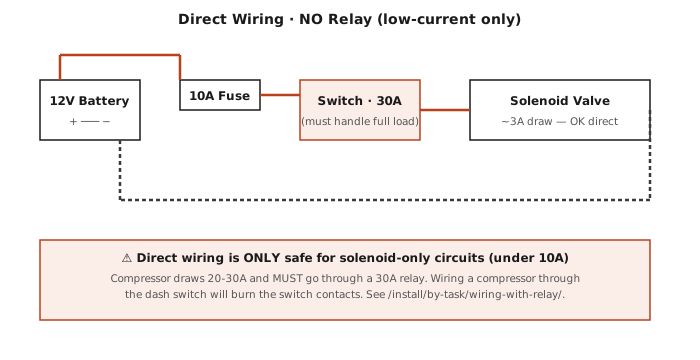
The no-relay topology
Direct push-button-to-solenoid wiring:
[Battery + 12V] ── 14 AWG ── 10A inline fuse ── push button (rated ≥ 20A) ── [Solenoid +]
                                                                                  │
                                                                                  ▼
                                                                          [Solenoid −] ── 14 AWG ── chassis ground
That’s the entire circuit. Press the button: 12 V flows through the fuse, through the button contacts, to the solenoid positive terminal. The solenoid coil energizes, the valve opens, air flows to the horn. Release the button: contacts open, coil de-energizes, valve closes via internal spring.
Step-by-step (no-relay topology)
- Disconnect battery negative terminal. Standard safety step.
- Mount the push button in the cab. SPST momentary switches work; rocker toggles also work but verify they’re momentary, not maintained (you don’t want the horn to stay on).
- Run a 14 AWG wire from the battery positive through a 10 A inline fuse (within 12” of battery+) into the cab via an existing firewall grommet.
- Connect that wire to one terminal of the push button.
- Run a second 14 AWG wire from the other button terminal back through the firewall to the solenoid positive terminal.
- Ground the solenoid negative terminal to the vehicle chassis on bare metal (paint stripped) using a ring terminal.
- Heat-shrink every connection. Important especially in engine bay where heat and humidity vary.
- Reconnect battery, test fire by pressing the button. The solenoid should click immediately and the horn should sound.
What about tapping the OEM horn button (no relay)?
A simpler “no-relay” install: use a MICRO2 add-a-circuit fuse-tap on the OEM horn fuse and run the tapped output directly to the solenoid coil. The 10 A fuse on the MICRO2 adapter provides current limiting; the OEM circuit handles ~5 A of solenoid coil load.
This works but isn’t truly relay-less — the OEM horn relay is still in the circuit, just hidden inside the OEM electronics. The solenoid is being switched by the same relay that switches the OEM horn.
For the MICRO2 fuse-tap procedure see /install/by-task/wiring-diagram/ and the F-150 install guide.
Why the compressor still needs a relay
A 12 V air compressor on a tank-fed kit draws 25 A continuous at 100 PSI (HornBlasters Conductor’s Special 228H spec). No common automotive button or toggle is rated for 25 A continuous. Common ratings:
| Switch type | Typical rating |
|---|---|
| Cheap rocker toggle | 5–10 A |
| Heavy-duty automotive toggle | 15–20 A |
| Industrial-rated toggle | 25–35 A (rare in automotive aftermarket) |
| Pushbutton (typical) | 5–15 A |
Even a 20 A heavy-duty switch is below the compressor’s 25 A continuous draw. Running the compressor through a switch will weld the contacts shut within minutes — at which point the compressor runs continuously until the tank explodes or the compressor burns out.
For the compressor, the relay topology is mandatory:
- Pressure switch (low current) opens/closes a relay coil
- Relay’s high-current contacts (rated 30+ A) handle the compressor 25 A draw
- See the universal wiring diagram page for the full topology.
Common no-relay-wiring problems
- Switch melts after a few months. Switch rating was below the solenoid’s actual draw. Replace with 20 A+ rated switch or upgrade to relay topology.
- Solenoid response is slow / intermittent. Long wire run at 5 A causing voltage drop. Add a relay or upsize the wire.
- OEM horn stops working. If you spliced into OEM horn wires directly (rather than using a MICRO2 add-a-circuit), the OEM circuit voltage drop is causing the issue. Add a relay or use the MICRO2 method.
- Reversed compressor polarity doesn’t apply here — this is solenoid-only wiring. But if you also wired the compressor without a relay, expect catastrophic switch failure.
- No flyback protection. The solenoid coil produces a back-EMF spike when de-energized. Some solenoids have built-in suppression diodes; if yours doesn’t, add a 1N4007 diode across the coil (cathode to +, anode to −) to protect the switch contacts.
Sources
- HornBlasters — Wiring the Motorcycle & Truck Electric Air Horns (relay pin assignments, wire gauge guidance)
- HornBlasters — Conductor’s Special 228H Train Horn Kit (compressor 25 A draw, solenoid current)
- the12volt — Air horns wiring discussion (community common-mistake catalog)
For the relay-based topology see /install/by-task/wiring-with-relay/ (forthcoming) and the universal wiring diagram page.
We do not perform hands-on wiring tests; verify all wiring against your kit manufacturer’s manual and your vehicle’s service documentation before powering up.