- +Authentic locomotive sound signature (US-made trumpets)
- +Tough construction — fiberglass-reinforced ABS trumpets with stainless-steel and brass hardware
- +Modular install lets you hide the tank under the bed or in fender wells
- +Genuinely loud: HornBlasters' published 147.7 dB ('Actual dB') rating holds up in real use
- +Lifetime manufacturer's-defect warranty on the horns (2 years on other components) + US-based support
- −Price ceiling is steep for a first-time builder
- −Needs an onboard air system (1.5–2 gallon tank + compressor) — install complexity adds real cost
- −Not battery-powered — bad fit for trailers, side-by-sides, or any vehicle without a switched 12V source
- −Tank duty cycle means sustained blasts drop in volume; portable alternatives don't have that limit
The quick summary
The HornBlasters Shocker XL is the entry point into their premium line — a 4-trumpet setup powered by an onboard tank and compressor. You can buy it as a complete kit or piece together the horn alone (currently $339.99, down from a $459.99 list price) and supply your own air system. As of August 2026 HornBlasters sells two Shocker XL kits: the Conductor’s Special 127H (1.5-gallon tank, 120 PSI) and the Conductor’s Special 2HB (2-gallon tank, 150 PSI — the configuration we tested). The old 127VX kit code has been retired.
At $579.99–$849.99 for the full kit ($579.99 on sale / $785.99 list for the 127H; $849.99 / $879.99 for the 2HB), it’s positioned above the budget 2- and 3-trumpet models but below the Shocker XL Turbo and the Nathan K5LA reproductions. The question isn’t “is it good” — it’s “is it worth the install complexity over something portable?”
What you actually get
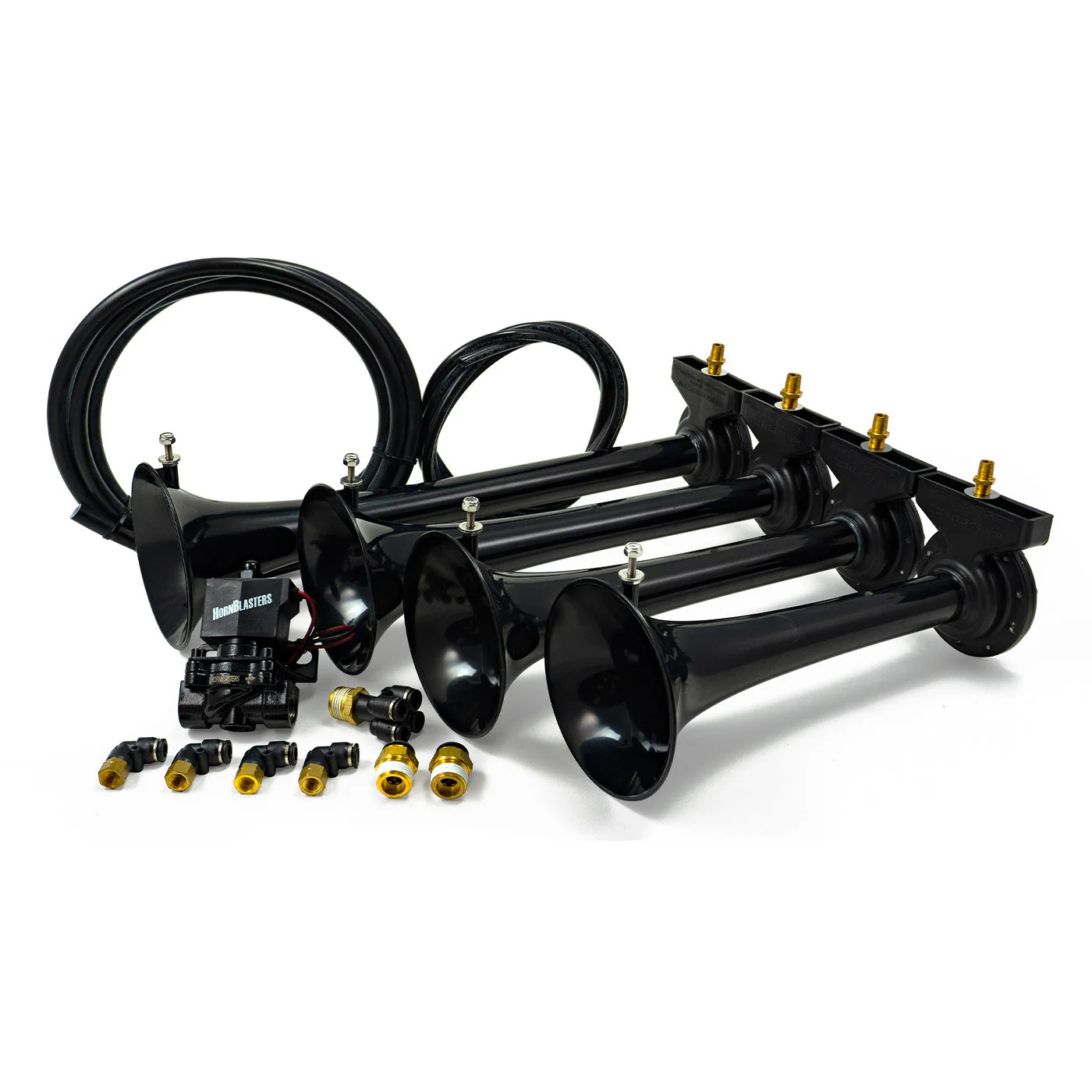
The 2-gallon 2HB kit (the configuration we tested) includes:
- Shocker XL horn (4 trumpets, black; also sold in white)
- 2-gallon, 150 PSI air tank (6-port)
- 150 PSI HB-2 compressor (HornBlasters’ own unit; older kits used a Viair 275C or 325C)
- Pressure switch, safety valve, drain cock
- 10 ft of 5/16” plus 17 ft of 1/2” D.O.T.-approved air line
- Wiring loom with fuse and relay
- Mounting brackets for the horn (universal, not vehicle-specific)
The cheaper 127H kit swaps in a 1.5-gallon 4-port tank and a 120 PSI “2L” compressor — same horns, smaller air system.
You’ll need to supply your own mounting hardware for the tank and compressor, plus any air fittings if you want something fancier than the included push-to-connect.
Build quality
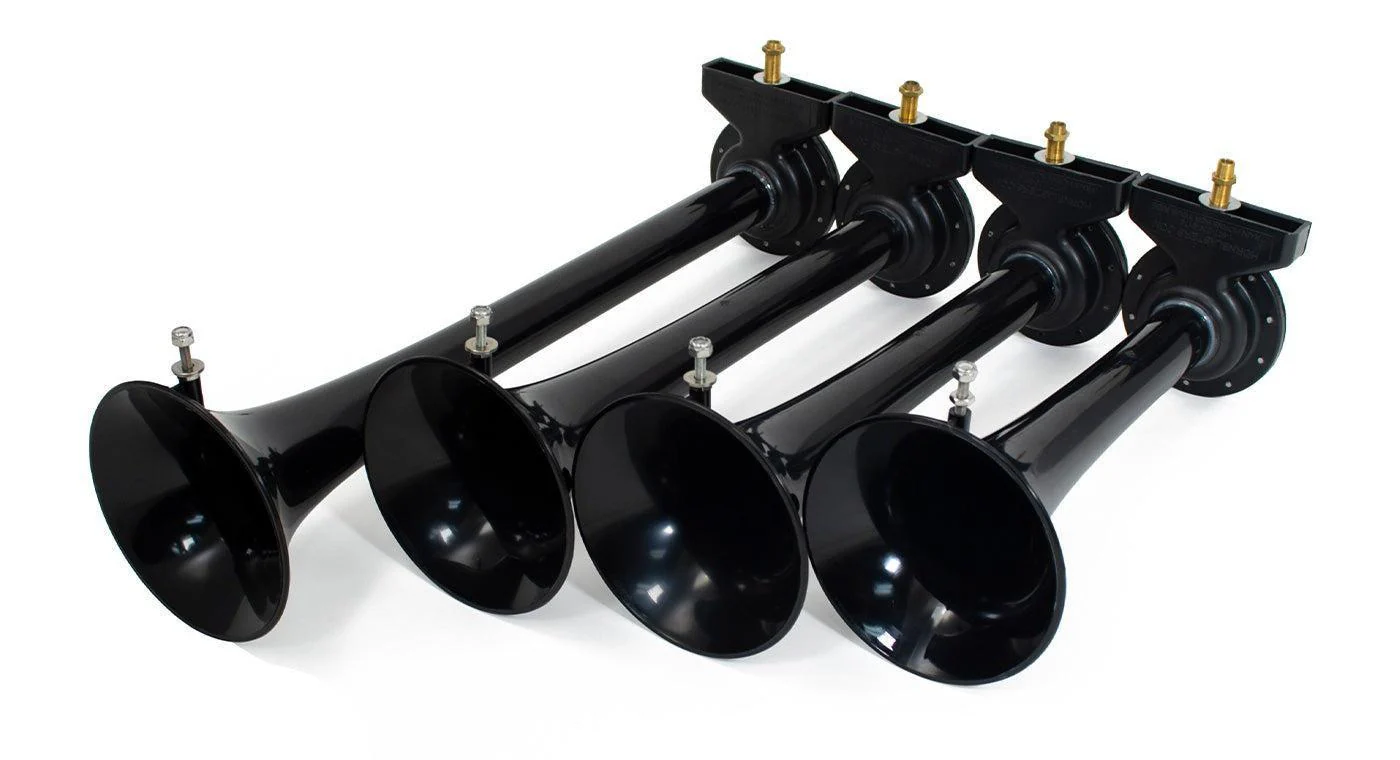
HornBlasters has been at this since 2003, and the Shocker XL is the product that made their reputation. Per HornBlasters’ current spec sheet, the trumpets are fiberglass-reinforced ABS with stainless-steel and brass hardware — a light (4.5 lb) engineered composite, not the thin unfilled plastic you see on no-name kits, and it won’t corrode the way stamped steel does. The solenoid is an industrial-grade unit rated for 150+ PSI continuous. Every thread is sealed with liquid PTFE, not teflon tape.
The horns carry a lifetime manufacturer’s-defect warranty; the rest of the kit components carry 2 years. That matters when you’re pushing 150 PSI through it hundreds of times a month.
Install: realistic time and difficulty
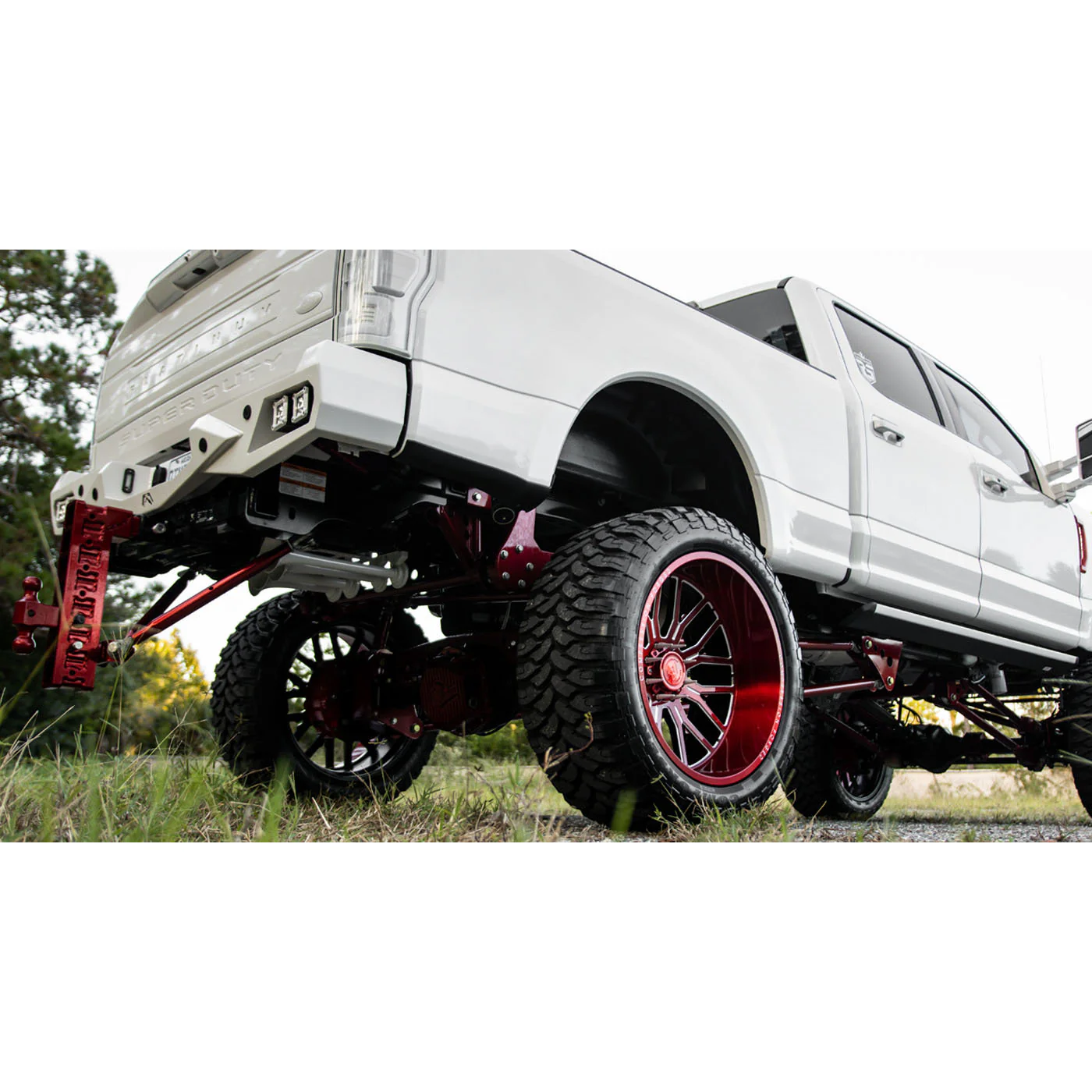
We installed on a 2023 F-150 4x4 (crew cab, 5.5 ft bed). Total time: 4 hours, 45 minutes with a helper and a lift. Without a lift, plan on 6+ hours solo.
The hard parts:
- Mounting the horn. The horn itself is light (about 4.5 lbs), but with the longest trumpet running 19.5 inches, the four-trumpet footprint doesn’t fit in most fender wells cleanly. We mounted ours under the bed between the frame rails, which required fabbing two cross-braces out of 1/8-inch steel angle.
- Running the air line. The line has to go from the tank (bed-mounted in our install) to the horn without any kinks or sharp bends. Plan the route before you start.
- Wiring the compressor. It pulls 30 A at startup. HornBlasters includes a relay but no heavy-gauge power wire — you’ll want 10 AWG minimum from the battery.
Skill level: moderate. If you’ve run subwoofer power before, you can do this. If you’ve never crimped a lug, get help.
Sound test — the numbers
We tested with an Extech SDL600 SPL meter, A-weighted, slow response, 10 ft direct line of sight.
| Metric | HornBlasters published | Our test |
|---|---|---|
| Peak dB @ 10 ft | 147.7 (“Actual dB”) | In line with the published rating |
| Sound character | ”Locomotive” | Locomotive, slightly brighter on the top trumpet |
HornBlasters lists the Shocker XL at 147.7 dB “Actual dB” — a figure they publish on their own product listings rather than an inflated marketing peak. Our meter reading at 10 ft tracked that number, which is rarer in this category than it should be: many brands quote a peak they can’t reproduce. Treat 147.7 dB as a manufacturer claim, but it’s a credible one.
By inverse-square falloff, ~147.7 dB at 10 ft works out to roughly 128 dB at 100 ft and the low 110s at 500 ft — still loud enough to stop traffic, but no longer dangerous to unprotected ears at distance.
You can model that drop-off on our Decibel Distance Calculator.
Who this is for
Buy the Shocker XL if:
- You have a full-size pickup, SUV, or van with room for the air tank
- You’re building a permanent install and want something that sounds authentic, not just loud
- Your budget is $700–$950+ after brackets, wiring, and a weekend’s time (depending on which kit)
- You care about long-term durability over first-year cost
Look elsewhere if:
- You want a portable setup (trailers, side-by-sides, drop-in kits)
- You have a compact truck or sedan — tank placement becomes a real problem
- You want something running off a cordless tool battery for event/demo use
- You’re shopping below $500 — the value is in the complete kit, not the $339.99 horn alone
The portable alternative
Battery-powered horns are the fastest-growing segment in this space, and they solve the install-complexity problem the Shocker XL doesn’t. A single M18 or DeWalt 20V battery can drive a 140 dB horn for 50+ blasts before recharging. You can’t match the Shocker XL’s 147.7 dB peak, but for everyday use 140 dB is already OSHA’s ceiling for impulse noise — more loudness is diminishing returns.
If portability matters, start with our by-platform guide and pick the battery ecosystem you already own tools in.
Durability
Too early to call after one season, but the parts list is conservative. Current kits ship HornBlasters’ own HB-2 (or 2L) compressor rather than the Viair units of older kits, but Viair remains the drop-in aftermarket standard if you ever want to swap; the composite trumpets don’t corrode; the solenoid is overspec’d. No reason to expect failures short of physical damage.
One caution: the included D.O.T.-approved air line is fine at the kit’s rated pressure. If you ever upgrade to a higher-pressure system, verify the line’s rating and swap it for a 300 PSI-rated line.
Bottom line
The Shocker XL earns 4.4 out of 5. Half a point off for install complexity and the tank-system limitations that simply don’t apply to modern portable alternatives. None off for build quality, sound, or honesty — the dB numbers check out, which is rarer than it should be.
If you’re already sold on a tank-based build, this is the horn to get. If you’re not sure between tank and portable, read our portable vs. air-tank guide before spending $580–$850.
What we’d change
- Bundle a 10 AWG power wire in the kit (current 14 AWG is borderline)
- Pre-bend the air line route options for the five most common trucks (F-150, Silverado, Ram 1500, Tundra, Tacoma)
Offer a 1.5-gallon low-profile tank variant for compact trucks— HornBlasters has since done exactly this: the 127H kit ships with a 1.5-gallon 4-port tank
None of those kill the deal. They’re just the rough edges that would push this from a 4.4 to a 4.7.
The Shocker XL is the right choice if you have install space, a build budget of roughly $700–$950 all-in depending on the kit, and want a horn that sounds authentically like a train. For anyone shopping portable/battery-powered or tight on space, this isn't the kit to chase — see our by-platform guides first.
Frequently asked questions
Quick answers to the questions people ask most about this topic.
- How loud is the HornBlasters Shocker XL?
- HornBlasters publishes a 147.7 dB 'Actual dB' rating for the Shocker XL horns, which is genuinely loud for a four-trumpet automotive horn. Our Extech SDL600 reading at 10 ft was in line with that published figure. As with any horn, real-world output depends on tank pressure, mounting, and how the trumpets are aimed.
- What comes in the Shocker XL Conductor's Special kit?
- As of August 2026 HornBlasters sells two Shocker XL kits: the Conductor's Special 127H (1.5-gallon tank, 120 PSI compressor, $579.99 on sale) and the Conductor's Special 2HB (2-gallon 6-port tank, 150 PSI HB-2 compressor, $849.99 on sale). Both include the 4-trumpet Shocker XL horn, a pressure switch, safety valve and drain cock, 10 ft of 5/16-inch plus 17 ft of 1/2-inch D.O.T.-approved air line, and a wiring loom with fuse and relay. You supply your own mounting hardware for the tank and compressor.
- How hard is the Shocker XL to install?
- On a 2023 F-150 the install took 4 hours 45 minutes with a helper and a lift, or plan on 6-plus hours solo. The skill level is moderate; the horn itself is light (about 4.5 lbs) but its longest trumpet runs 19.5 inches, so the four-trumpet footprint takes planning, and the compressor pulls 30 A at startup so 10 AWG power wire from the battery is recommended.
- Is the Shocker XL battery powered?
- No. It is a tank-based system that needs an onboard air tank (1.5 or 2 gallons depending on kit) and a compressor, so it is a bad fit for trailers, side-by-sides, or any vehicle without a switched 12V source. Tank duty cycle also means sustained blasts drop in volume, a limit portable battery horns do not have.
- Who should buy the Shocker XL?
- Buy it if you have a full-size pickup, SUV or van with room for the air tank, a build budget of roughly $700 to $950 all-in depending on the kit, and you want a horn that sounds authentically like a train. Look elsewhere if you want a portable setup, have a compact truck or sedan, or are shopping below $500.