How to Install a Train Horn on a Ram 1500 (2013–2026)
Train horn install for Ram 1500 — spare-tire-delete vs frame-rail mounting, 4th and 5th gen specifics, OEM horn fuse-tap wiring, kit options, common issues.
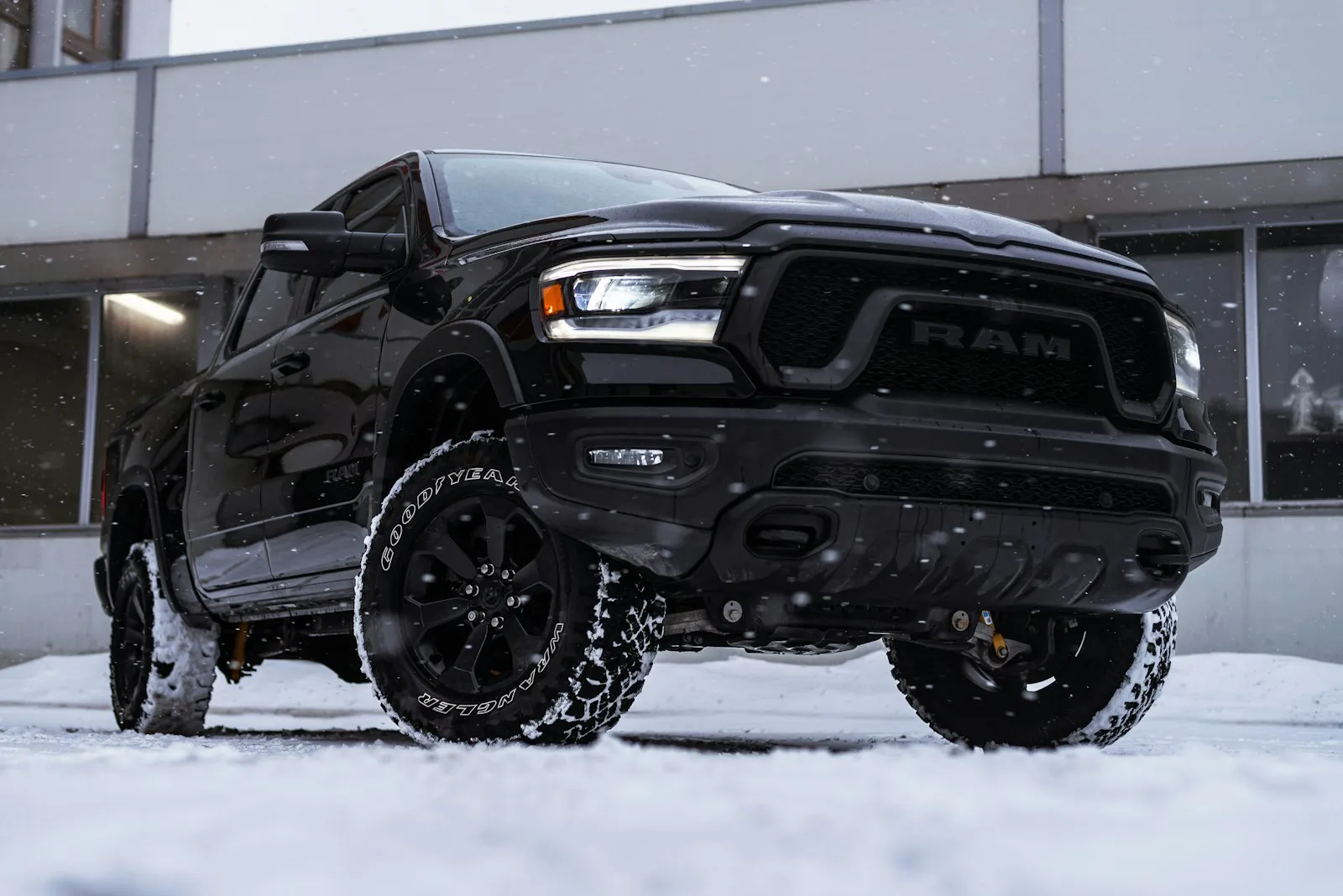
The Ram 1500 is the second-most-installed truck for aftermarket train horns in the U.S., behind the Ford F-150. Three solid mounting options — spare-tire-delete, outside passenger frame rail, or behind front bumper — work across the 4th-generation (2009–2018) and 5th-generation (2019–2026) trucks. This guide consolidates HornBlasters’ 2019 Ram 1500 install write-ups (Eric’s, Angel’s, Ryan’s), AmericanTrucks’ Universal Spare Tire Location bracket documentation, and 5thGenRams.com / RamForum.com community threads.
- Difficulty
- Moderate
- Mechanical aptitude required
- Time
- 3–4 hr (kit-style)
- 6–8 hr if no spare-tire-delete
- Cost
- $1,000–$5,500
- Kit + mount + parts
- Best mount
- Spare tire well
- Or outside passenger frame rail
- Generations
- 4th & 5th gen
- 2009–2018 / 2019–2026
- Air system
- 5-gal tank min
- 1NM-class compressor
Quick stats
- Difficulty: Moderate. You should be comfortable lowering the spare tire, removing the spare tire winch, and tapping the OEM horn fuse circuit.
- Time: 3–4 hours with a vehicle-specific spare-tire-delete bracket; 6–8 hours with custom fabrication.
- Cost: $1,000 entry-level Vevor / Kleinn kit up to $5,500+ for a full HornBlasters Shocker XL or Nathan AirChime K5LA install with a vehicle-specific mount.
- Tools: Standard socket set, drill, wire crimpers, multimeter, fuse puller, MICRO2 add-a-circuit adapter.
- Best mount option for most builds: Spare-tire-delete bracket — the 5th-gen Ram has generous space below the bed where the OEM spare hangs.
Mounting options by generation
The Ram 1500 has had two distinct architectures across the 2013–2026 window. Pick by generation.
4th gen (2009–2018)
- Spare tire location: AmericanTrucks lists a Universal Spare Tire Location Train Horn Bracket that fits this generation with some adaptation. The OEM spare hangs below the bed on a winch cable; remove the spare and the winch mechanism, install the bracket, and the train horn slides into the same envelope.
- Outside passenger frame rail: A second AmericanTrucks variant — the Spare Tire Location OnBoard Air System bracket — combines tank and compressor mounting.
- Behind front bumper: Trumpets only, with air chucks routed back through the engine bay. Common on community builds; lower profile but more exposure to road salt.
5th gen (2019–2026, including DT-platform Ram 1500)
- Spare tire location (recommended): Per 5thGenRams.com mounting threads, the cleanest install is “tank and horns where the spare goes, with the compressor mounted on the frame under the passenger rear door.” This is the topology used in HornBlasters’ Eric’s 2019 Ram 1500 install, Angel’s 2019 install, and Ryan’s 2019 install.
- Driver’s side frame: Some 5th-gen builders mount horns under the driver’s door area with the tank and compressor tucked up along the frame. Useful if exhaust routing on the passenger side is in the way.
- HornBlasters Goliath-class mount: Currently sold for the F-150 platform, but HornBlasters’ Goliath Mount page describes the bolt-on flat-mount approach that the Ram-specific brackets follow.
Recommended kits
Three kits ordered by price tier:
- HornBlasters Conductor’s Special 228H — $649.99–$749.99. 147.7 dB Shocker XL trumpets on a 2-gallon tank. Fits the spare-tire-delete envelope on the 5th-gen Ram 1500 with room to spare. Best dB-per-dollar in the category.
- HornBlasters Shocker XL Kit — $1,800–$2,200. Same trumpets on a 5–8 gallon tank for sustained 5–10 second blasts.
- Nathan AirChime K5LA Kit — $4,999.99 (HD-544K) or $5,199.99 (XD-844K). Real locomotive horn at the 149.4 dB ceiling.
For portable / no-install alternatives see the Milwaukee M18 and DeWalt 20V MAX battery-powered hubs.
Step-by-step (kit + spare-tire-delete on a 5th-gen Ram 1500)
This sequence assumes a 2019–2026 Ram 1500 with the AmericanTrucks Universal Spare Tire Location bracket and a 5-gallon tank / single 1NM compressor air system. Adapt for 4th-gen or larger kits. Total time: 3–4 hours.
- Disconnect battery negative terminal. Standard safety step; prevents accidental shorts.
- Lower the spare tire using the OEM winch crank (accessed through the rear bumper or behind the rear license plate per your year). Set the spare aside.
- Remove the spare tire winch mechanism. Two 13 mm bolts on the crossmember and the cable hook itself. Save the hardware.
- Test-fit the spare-tire-location bracket in the empty spare envelope. Mark any holes that need drilling — the AmericanTrucks listing notes “some adaptation may be required.”
- Drill marked holes and bolt the bracket to the frame rails. Torque to spec (≈ 30 ft-lb for 13 mm hardware).
- Mount the train horn to the bracket using the supplied U-bolts or clamp hardware. Position trumpets pointing rearward, slightly down. Verify clearance from the exhaust pipe.
- Mount the air tank to the bracket using the included tank straps. Tank on its long axis with the drain valve facing the ground.
- Mount the compressor on the passenger-side frame rail under the rear cab door (per the HornBlasters reference installs) or alongside the tank if the bracket allows.
- Run air lines. 1/2” PTC fitting from compressor → tank in port; 1/2” PTC from tank out port → solenoid valve → horn. Use rubber-lined clamps every 18”.
- Run the compressor power wire (8 AWG positive + ground) from the engine bay battery to the compressor. Use existing OEM grommet pass-throughs. Inline 30 A fuse within 12” of battery positive.
- Run the solenoid trigger wire (18 AWG) from the cab to the solenoid.
- Tap into the OEM horn fuse circuit (see “Wiring to the steering wheel button” below) or run a separate cab-mounted toggle / push button.
- Ground the solenoid to the vehicle frame using a ring terminal on a clean (paint-stripped) bolt location.
- Reconnect the battery, prime the system (compressor will run for ≈ 6 min 45 s to fill from 0 → 150 PSI on a 5-gallon tank with 1NM compressor; ≈ 3 min 5 s for the 228H 2-gallon kit).
- Test fire the horn first by manually shorting the solenoid trigger to 12 V, then via the OEM steering wheel button.
Wiring to the steering wheel button (Ram 1500)
The Ram 1500 OEM horn fuse lives in the engine bay fuse box (TIPM in 4th gen; PDC in 5th gen). The MICRO2 add-a-circuit method below is the same approach documented by HornBlasters for the F-150 and broadly applies across body-on-frame trucks.
- With battery still disconnected, locate the horn fuse in the engine bay fuse box. Reference the cover diagram for your year — the fuse position is labeled.
- Remove the original horn fuse using a fuse puller.
- Insert a MICRO2 add-a-circuit adapter in the horn fuse position with the original fuse re-inserted into the adapter’s “interior” terminals (this keeps the OEM horn working).
- Insert a 10 A MICRO2 fuse into the adapter’s “exterior” terminals — this becomes your train-horn solenoid trigger.
- Crimp an 18 AWG wire to the adapter’s pigtail and route it through the firewall to the train horn solenoid’s positive terminal.
- Ground the solenoid’s negative terminal to the vehicle frame.
- (Optional) Splice a cab-mounted toggle inline between the adapter and the solenoid for “horn arm/disarm” override.
- Reconnect the battery, press the steering wheel horn button — both OEM horn and train horn fire together.
For the full universal wiring topology (both compressor relay circuit and solenoid trigger circuit), see /install/by-task/wiring-diagram/.
Common problems
Distilled from 5thGenRams.com, RamForum.com, RamForumz.com, and HornBlasters’ Ram-specific install pages:
- Bracket fits “with adaptation.” AmericanTrucks explicitly notes the universal bracket may need additional drilling on some Ram model years. Test-fit before committing to the install.
- Spare tire winch cable retains tension. Lower the winch fully before unbolting the mechanism, otherwise the cable can spring back when the last bolt comes out.
- Compressor mounting on the passenger-side frame is tight near the exhaust. Verify clearance — the catalytic converter and downstream exhaust runs along this side. Heat-shield the compressor mount or relocate to the driver’s side.
- OEM horn stops working after fuse-tap. MICRO2 adapter has the original fuse on the wrong side. The original fuse must be in the interior terminals (closer to fuse box body); the new 10 A trigger fuse goes in the exterior terminals.
- Horn fires but tank pressure drops fast. 2-gallon tank is normal — 3–5 second blast then 55-second recovery. If you want longer blasts, upgrade to a 5-gallon kit.
- Compressor hums but doesn’t pump. Reversed polarity. Per HornBlasters wiring guidance, “grinding indicates reversed polarity at compressor connections” — swap +/− leads.
- Vibration noise transmits into the cab. Use heavy-duty rubber-isolated mounts between the compressor and frame bracket. Some 5thGenRams.com builders use velcro plus rubber padding to dampen.
Legal reminder
A train horn install on a Ram 1500 is legal in most U.S. states for the horn hardware itself, but using it on a public road typically violates state vehicle codes (most cap horn output around 110 dB; FMVSS 141 caps replacement passenger-vehicle horns at 118 dB at 2 m forward — well below the 144–158 dB output of locomotive- and Shocker-class kits). For state-by-state caps see the legal hub and state legality lookup.
Sources
- AmericanTrucks — Ram 1500 Universal Spare Tire Location Train Horn Bracket Kit (2009–2026 fitment)
- AmericanTrucks — Ram 1500 Universal Spare Tire Location Train Horn OnBoard Air System Bracket (combined tank + compressor mounting)
- HornBlasters — Eric’s 2019 Dodge Ram 1500 Install (5th-gen reference build)
- HornBlasters — Angel’s 2019 Ram 1500 Install
- HornBlasters — Ryan’s 2019 Dodge Ram 1500 Install
- HornBlasters — Goliath Mount Page (bolt-on flat-mount approach reference)
- 5thGenRams.com — Train Horn Mount Locations discussion (community-sourced 5th-gen mounting tips)
- 5thGenRams.com — Train Horn Install discussion (electrical / wiring discussion)
- RamForumz — Train Horn Mounting Location (4th-gen mounting tips)
We do not perform hands-on installs. This guide aggregates publicly available install documentation and community discussions. Verify all wiring against your vehicle’s year-specific service manual before powering up.