- +147.7 dB measured — same trumpet hardware as the flagship Shocker XL kit
- +Compact 2-gallon tank fits installs where space is tight (under-bed, behind grille, smaller SUVs)
- +Fast 3 min 5 sec fill from 0–145 PSI; 55 sec recovery between blasts
- +Lifetime horn warranty plus 2-year kit warranty
- +Includes everything: pre-plumbed tank/compressor, valve, wiring, fittings, instructions
- −Only 3–5 second blasts before tank pressure drops below horn's operating range
- −2-gallon tank limits sustained or repeated honks compared to the 5/8-gallon kits
- −228H compressor maxes at 25 A continuous — sized exactly for the load with no margin
- −Fiberglass-reinforced ABS trumpets aren't as durable long-term as cast metal in salt environments
- −147.7 dB at 3 ft is well above the statutory ~110 dB road limit in most U.S. states
Methodology
This review aggregates publicly available information from HornBlasters’ product pages, retailer listings, and HornBlasters’ own published dB testing methodology. We do not perform hands-on testing of train horns. All numeric claims cite their source. Last reviewed: August 7, 2026.
Quick verdict
The Conductor’s Special 228H is, in editorial opinion, the best value entry into the 147+ dB tier of train horns. It uses the same four Shocker XL trumpets that power the brand’s larger kits (up to about $1,210 for the 8-gallon dual-compressor 844K) — at $650–$750 — by pairing them with a smaller 2-gallon tank and a single 228H compressor. The compromise is blast duration, not volume: you get 3–5 second honks instead of the 10–12 seconds the 5-gallon 544K delivers, and recovery between blasts takes about a minute. We rate it 4.5/5 for buyers who want maximum dB-per-dollar without committing to a full Shocker XL kit.
What it is
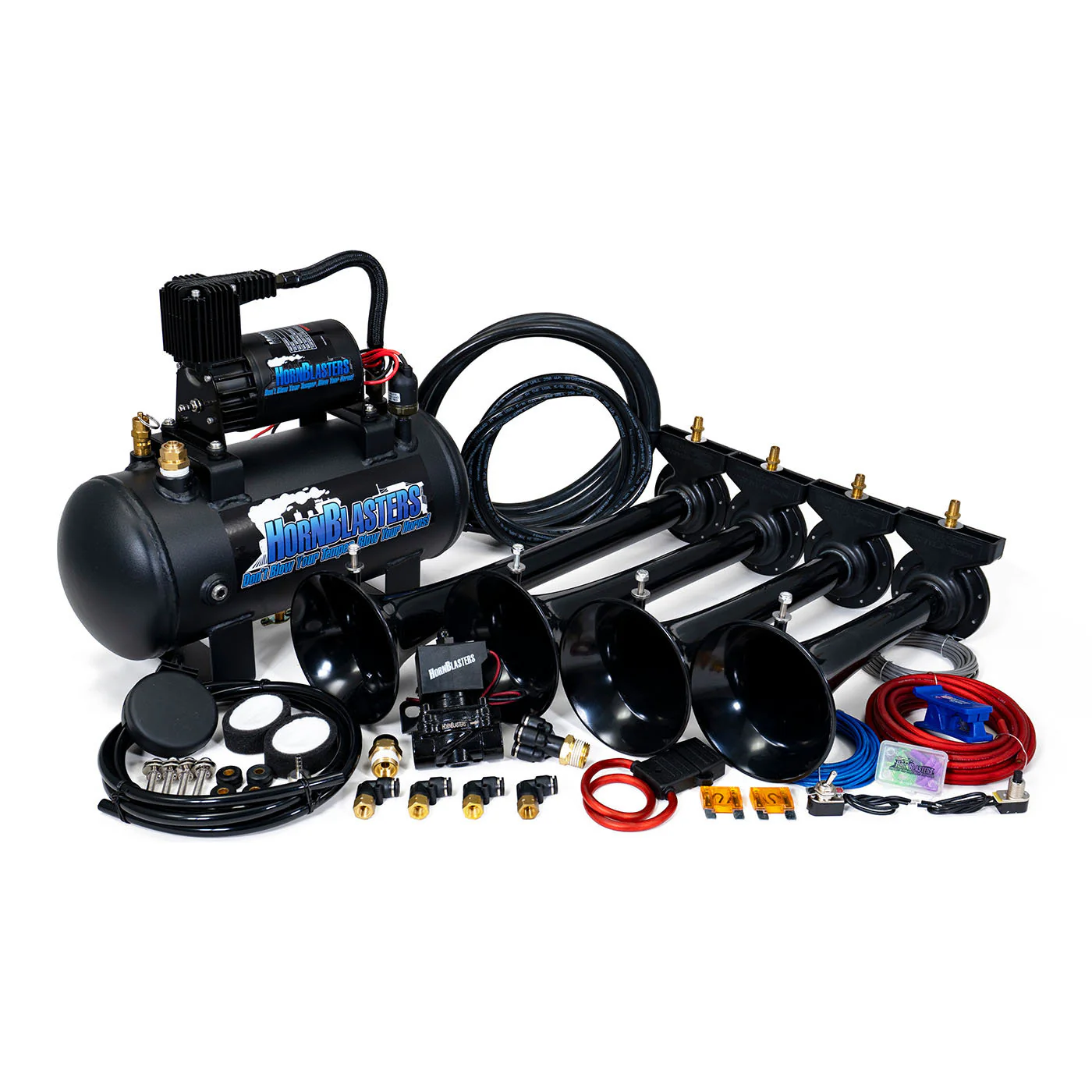
The Conductor’s Special 228H is HornBlasters’ compact air-tank kit (HornBlasters product page). The kit pairs four Shocker XL trumpets — the same horn hardware used in the flagship Shocker XL kit — with a 2-gallon tank and a single 228H compressor sized to refill it. The “228H” designation refers to the compressor model in the air source unit; “Conductor’s Special” is the product family.
Three things distinguish it from the larger HornBlasters kits:
- Smaller tank (2 gal vs 5–8 gal on the larger kits)
- Single compressor (vs dual 1NM compressors on the 8-gallon 844K)
- Shorter installation footprint — fits behind a truck bed wall, in a spare tire well of a smaller SUV, or even behind a front grille
Specifications
All figures from the HornBlasters product page:
| Spec | Value |
|---|---|
| Sound output | 147.7 dB at standard 3-ft test distance |
| Trumpet count | 4 |
| Trumpet sizes | 19.50″ / 16.25″ / 14.75″ / 12.75″ (long, slot-loaded) |
| Trumpet material | High-impact fiberglass-reinforced ABS, stainless internals |
| Trumpet flare | 5″ |
| Tank volume | 2.0 gal (8.8 L) |
| Operating pressure | 150 PSI |
| Restart (cut-in) pressure | 110 PSI |
| Compressor | HornBlasters 228H |
| Fill rate (0 → 145 PSI) | 3 min 5 sec (±10 sec) |
| Recovery (110 → 145 PSI) | 55 sec (±5 sec) |
| Max current | 25 A |
| Honk duration | 3–5 sec |
| Air source weight | 17.15 lb |
| Voltage | 12 V DC |
| List price | $827.99 |
| Sale price | $649.99 (Black) / $659.99 (White) / $749.99 (some retailers) |
| Horn warranty | Lifetime |
| Kit warranty | 2 years (manufacturer’s defect) |
What’s in the box
Per the HornBlasters product listing, the kit ships pre-plumbed and pre-wired with:
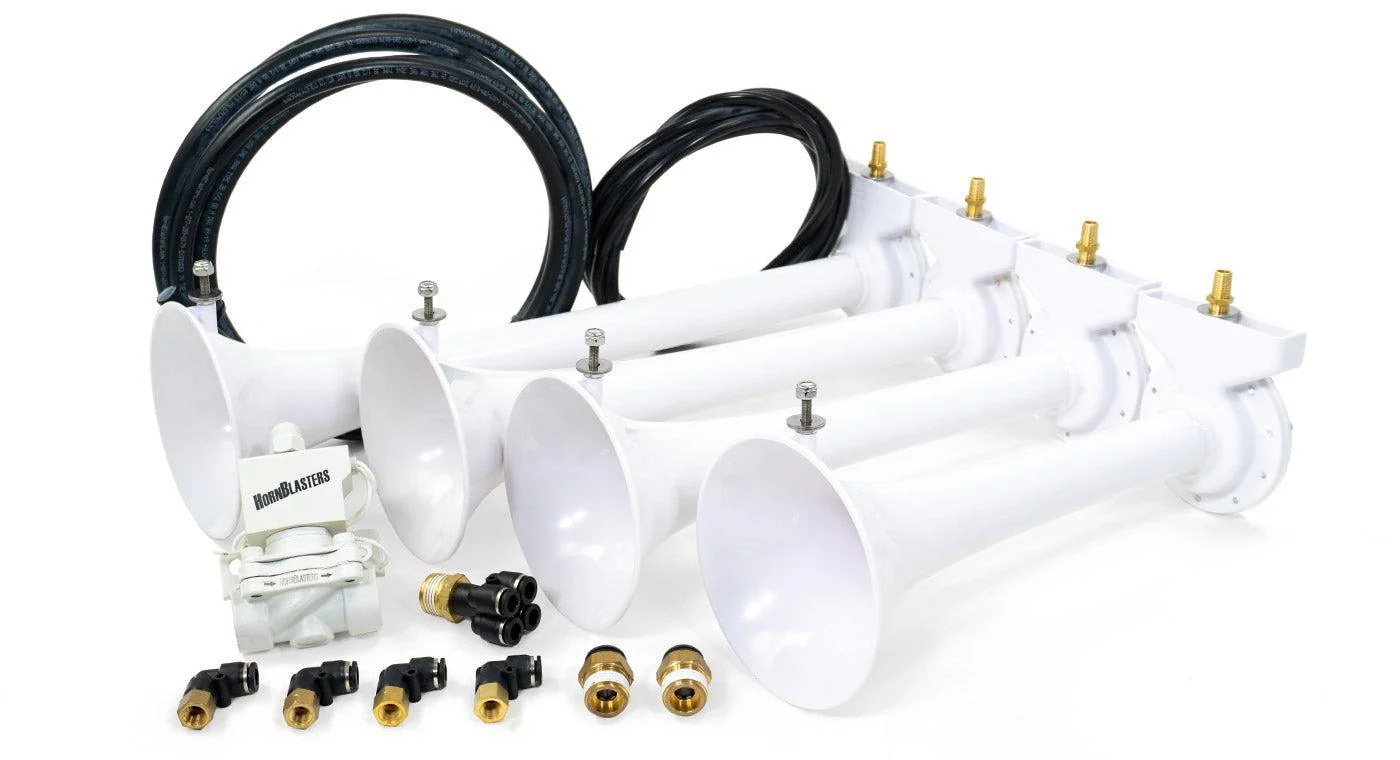
- 4 Shocker XL trumpets (assembled with manifold)
- 228H air source unit (tank + compressor + pressure switch, pre-assembled)
- 1/2″ Black Widow electric solenoid air valve
- Air lines (1/4″ and 1/2″ as needed)
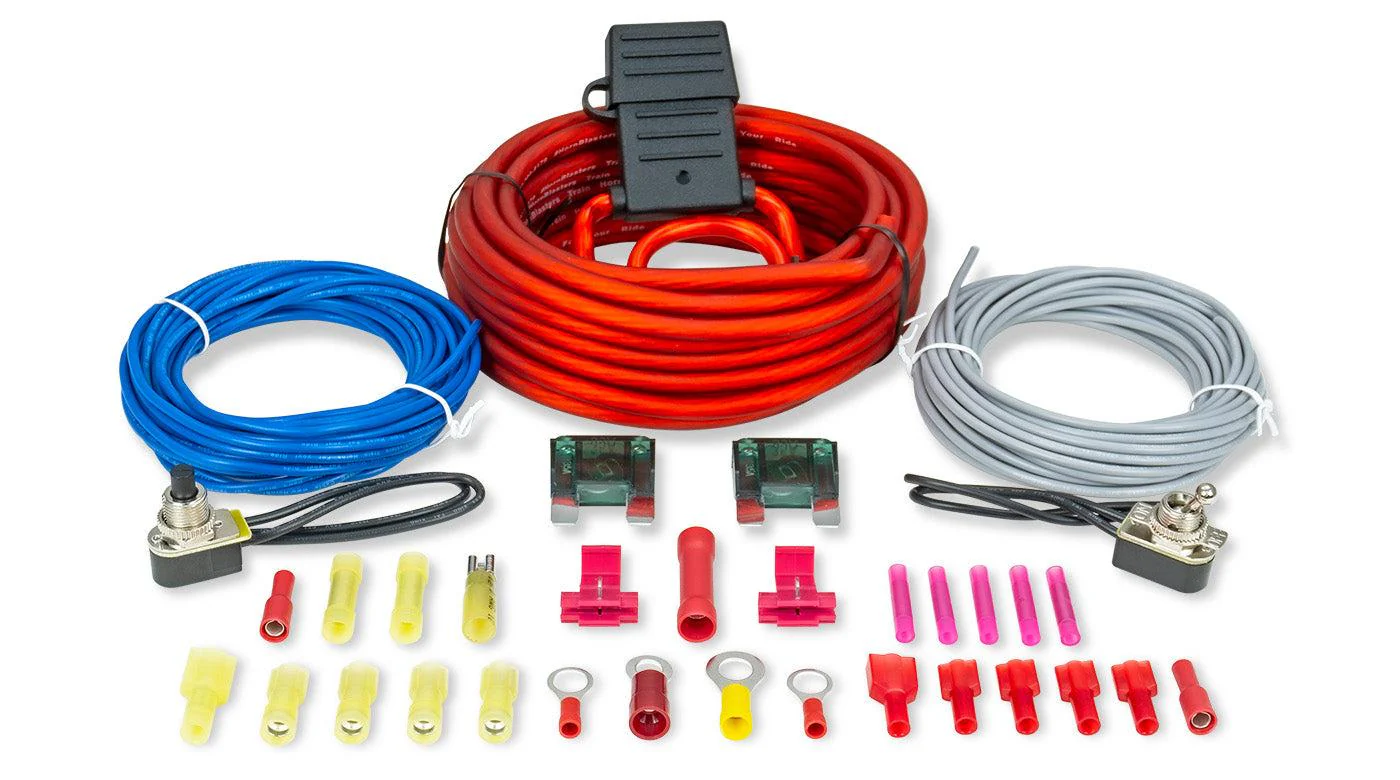
- Complete wiring kit (gauge wire, fuse holder, relays)
- Mounting hardware
- Installation instructions
This is significant: the air source unit comes pre-plumbed, so you don’t have to thread the tank into the compressor mounting point yourself. Cuts installation time vs sourcing the parts separately.
Compared to the Shocker XL kit
| Spec | Conductor’s Special 228H | Other Shocker XL kits (127H–844K) |
|---|---|---|
| Trumpets | 4 (same hardware) | 4 (same hardware) |
| dB at 3 ft | 147.7 | 147.7 |
| Tank | 2 gal | 1.5–8 gal depending on kit |
| Compressor | Single 228H | single integrated up to dual 1NM (844K) |
| Honk duration | 3–5 sec | up to 10–12 sec (5-gal 544K) |
| Recovery | 55 sec for 110 → 145 PSI | ~2 min on the 5-gal 544K |
| Max amperage | 25 A | varies by kit |
| Kit price | $650–$750 | $580–$1,210 (1.5-gal to 8-gal kits) |
| Best for | Tight installs, value buyers | Sustained honks (larger tanks) |
The trumpet hardware is identical across the lineup. If your priority is the longest possible blasts and you can fit a larger tank, the 544K or 844K gives you 10+ seconds of honk. If your priority is space, weight, and budget — and you don’t need to honk for 10 seconds straight — the 228H delivers the same instant volume.
Pros and cons
Pros:
- Real 147.7 dB at 3 ft (HornBlasters published rating with disclosed methodology). Same trumpets as the flagship.
- Compact air source unit at 17.15 lb fits installs that won’t take a 5+ gal tank.
- Fast initial fill (3 min 5 sec from 0 to 145 PSI) and reasonable recovery (55 sec) for the tank size.
- Lifetime horn warranty is the longest in the aftermarket air-horn category.
- Pre-plumbed kit reduces install complexity vs sourcing parts separately.
Cons:
- Only 3–5 second blasts before tank pressure falls below the horn’s operating range. Not suited to repeated rapid-fire honking without a 55-second pause.
- Single 228H compressor at 25 A continuous is sized exactly for the tank — no headroom if you want to upgrade to a larger tank later without swapping the compressor.
- Fiberglass-reinforced ABS trumpets are durable but won’t last as long as cast metal in salt-air or road-salt environments.
- 147.7 dB at 3 ft exceeds typical state caps (~110 dB) by a wide margin — see legal hub for state-by-state caps.
Alternatives
Three credible alternatives to compare:
- HornBlasters Shocker XL Kit — same 147.7 dB trumpets; complete kits run $579.99 (1.5-gallon 127H) up to about $1,210 (8-gallon dual-compressor 844K), with the larger tanks giving longer blasts. The right pick if blast duration matters and you have install space.
- Nathan AirChime K5LA Kit — real locomotive horn, 149.4 dB ceiling, $4,999.99 starting. The right pick if you specifically want the freight-train chord (B major 6th) instead of the four-trumpet Shocker sound.
- HornBlasters Conductor’s Special 544 Nightmare — same Shocker XL trumpets on a 5-gallon tank with the 1NM compressor, good for 10–12-second honks per fill. Sells for $1,049.98 on sale ($1,149.99 list) as of August 2026.
For portable / battery-powered alternatives that skip the air system entirely, see Milwaukee M18, DeWalt 20V MAX, Ryobi ONE+, and Makita LXT hubs.
Frequently asked questions
Is the 228H really the same dB as the Shocker XL kit?
Yes. The trumpets are identical — same Shocker XL hardware, same dimensions (19.50″ / 16.25″ / 14.75″ / 12.75″), same fiberglass-reinforced ABS construction. The 147.7 dB rating applies to both kits. What differs is the air system feeding those trumpets: a 2-gallon tank in the 228H, a 5- or 8-gallon tank in the larger 544K and 844K kits.
What’s the difference between the Conductor’s Special 228H and the Conductor’s Special 544?
The compressor and tank. 228H = the 228H compressor + 2-gallon tank, 3–5 second blasts. 544 = the 1NM compressor + 5-gallon tank, with 10–12-second blasts per fill (recovery takes longer — about 2 minutes from 110 to 150 PSI, per HornBlasters). Same trumpets on both.
How many honks before the compressor needs to refill?
A typical honk consumes ~30–50% of tank capacity at the horn’s operating PSI. With the 2-gallon 228H tank, that’s roughly 1–2 full honks before recovery. The 55-second recovery time at the 110 PSI cut-in restores the tank to operational pressure between honks.
Can I upgrade the 228H tank later?
Partly. The trumpet manifold and valve are tank-agnostic, so a larger tank gets you longer blasts — but the 228H’s compressor ships integrated with its 2-gallon tank as a pre-assembled air source unit, and HornBlasters notes that detaching the compressor voids the warranty. In practice, upgrading capacity means replacing the whole air source unit (or stepping up to the 5-gallon 544K kit from the start). For a tighter calculation use the air tank runtime calculator and compressor recovery calculator.
Will it fit in an F-150 spare tire well?
Yes — the 17.15 lb air source unit fits inside the spare tire location of all three modern F-150 generations (12th, 13th, 14th). For specific bracket and mounting recommendations see the F-150 install guide.
Is it legal to use on the road?
In most U.S. states, no — at full output. State vehicle codes typically cap horn output around 110 dB at the source or front of vehicle. 147.7 dB exceeds that by a wide margin. Installing the kit is generally fine; using it on a public road exposes you to citations under state vehicle code §27001-equivalent statutes. See our legal hub for state-by-state caps and the state legality lookup.
What’s the wiring topology for the 228H kit?
The kit ships with a complete wiring harness: relay-switched 12 V DC for the compressor (controlled by the pressure switch), and a separate solenoid valve trigger circuit. Ties into the OEM horn fuse via a MICRO2 add-a-circuit adapter or a dedicated cab-mounted button. Procedure detailed in our universal wiring diagram page.
How does the 147.7 dB rating compare to the verified ceiling?
The verified record for any train horn is the Nathan AirChime K5 at 149.4 dB at 3 ft (HornBlasters dB methodology). The 228H at 147.7 dB is 1.7 dB below the published ceiling — perceptually about 10–15% quieter than a real K5LA. Anything advertising more than 150 dB at 3 ft is marketing, not measurement; see The Loudest Train Horns in the World.
Sources
- HornBlasters — Conductor’s Special 228H Train Horn Kit (product page) (kit specs, pricing, fill rate, warranty terms)
- HornBlasters — Train Horn Decibel Guide (K5 vs Shocker XL loudness ranking, third-party DJD Labs test reference)
- HornBlasters — Why Fake Decibel Ratings Mislead Buyers (3-ft test distance methodology, debunking of 150+ dB claims)
- Amazon — HornBlasters Conductor’s Special 228H listing (cross-verification of 147.7 dB, weight, kit contents)
- Raney’s Truck Parts — HornBlasters Conductor’s Special 228H (retailer pricing reference)
Train Horn aggregates publicly available data. We do not test products in-house. All trademarks belong to their respective owners. Pricing and availability verified August 7, 2026.
If you want the loudness of the larger 5- and 8-gallon kits ($1,050–$1,210) but can live with shorter blasts and a smaller tank, the 228H gets you there for under $700. The compromise is duration, not volume — same trumpets, less air.
Frequently asked questions
Quick answers to the questions people ask most about this topic.
- How loud is the Conductor's Special 228H?
- It is rated at 147.7 dB at the standard 3-foot test distance, which is HornBlasters' published rating with disclosed methodology. That uses the same four Shocker XL trumpets found in the brand's flagship kits.
- Is the 228H really the same dB as the Shocker XL kit?
- Yes. The trumpets are identical Shocker XL hardware with the same dimensions and fiberglass-reinforced ABS construction, so the 147.7 dB rating applies to both. What differs is the air system: a 2-gallon tank in the 228H versus a 5- or 8-gallon tank in the larger kits like the 544 Nightmare.
- How long can the Conductor's Special 228H honk before refilling?
- The 2-gallon tank gives 3 to 5 second blasts before pressure drops below the horn's operating range. The compressor then recovers in about 55 seconds at the 110 PSI cut-in, and a full fill from 0 to 145 PSI takes 3 minutes 5 seconds.
- Will the Conductor's Special 228H fit in an F-150 spare tire well?
- Yes. The 17.15 lb air source unit fits inside the spare tire location of all three modern F-150 generations (12th, 13th and 14th).
- Is the Conductor's Special 228H legal to use on the road?
- In most U.S. states, no, not at full output. State vehicle codes typically cap horn output around 110 dB, and 147.7 dB at 3 ft exceeds that by a wide margin. Installing the kit is generally fine, but using it on a public road can expose you to citations.
- What warranty does the Conductor's Special 228H carry?
- It comes with a lifetime warranty on the horn itself, which the review notes is the longest in the aftermarket air-horn category, plus a 2-year manufacturer's defect warranty on the kit.