Disclaimer. This page summarizes publicly available Alabama statutes as of June 2026 and is published for general informational purposes only. It is not legal advice, and nothing on this page creates an attorney–client relationship. State laws change, enforcement varies by jurisdiction, and individual circumstances matter — always verify the current statutory text and consult a licensed Alabama attorney before making installation or use decisions that may carry legal consequences.
- Legal status
- Legal
- Install permitted
- Statute
- §32-5-213
- Ala. Code Title 32
- Audibility required
- 200 ft
- Factory horn minimum
- Specific dB cap
- None
- "Unreasonably loud" test
- Siren ban?
- Yes
- Emergency vehicles exempt
- Penalty class
- Misdemeanor
- Per §32-5-213
Short answer
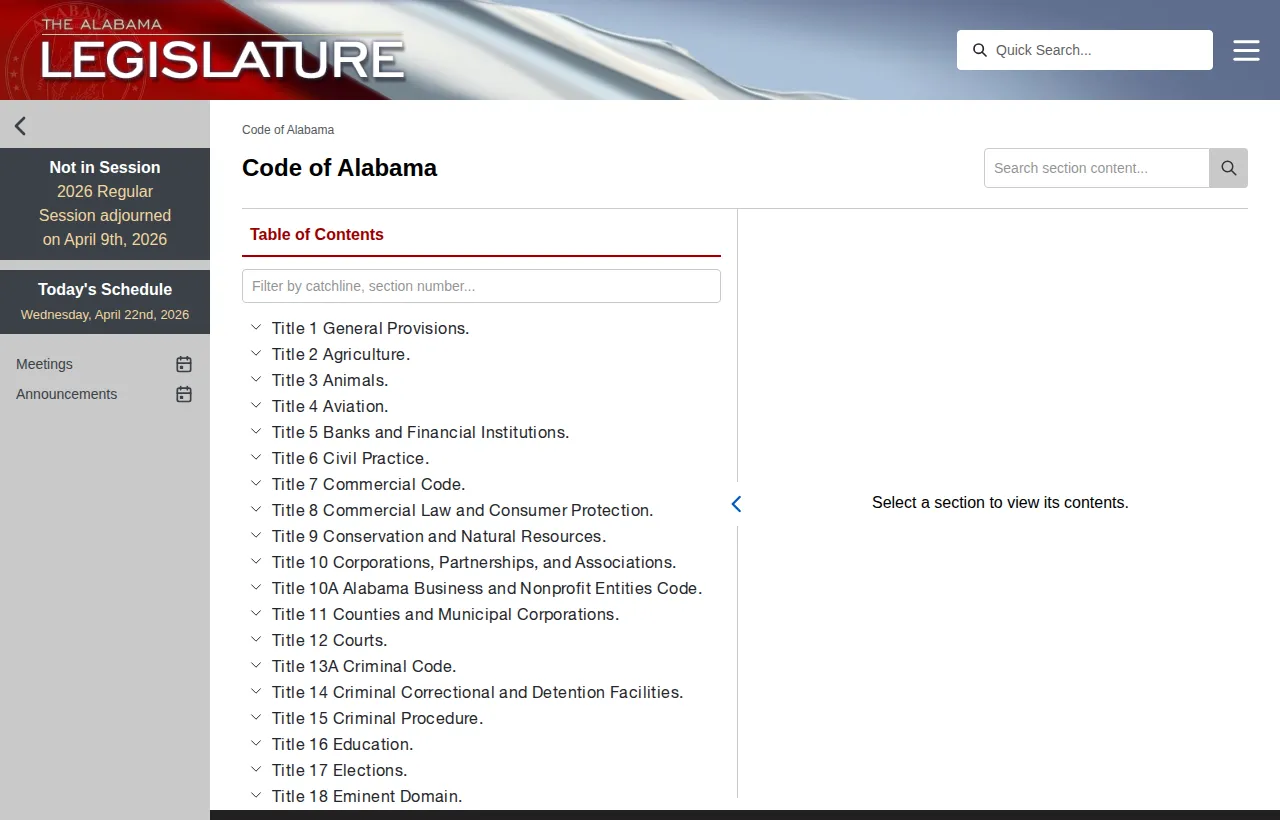
Installing a train horn on a private vehicle in Alabama is not prohibited by statute. Alabama law requires every motor vehicle to have a working horn audible at 200 feet, and separately prohibits using a horn to make “unnecessary or unreasonably loud or harsh” sound. The installation allowance and the use restriction sit in the same section — Ala. Code §32-5-213 (official Alabama Legislature database).
In practice: a train horn can stay installed on your vehicle, but using it on a public road in a way an officer judges “unreasonably loud” is the infraction.
What the statute actually says
Every motor vehicle when operated upon a highway shall be equipped with a horn in good working order capable of emitting a sound audible under normal conditions for a distance of not less than 200 feet. It shall be unlawful for any vehicle to be equipped with or for any person to use upon a vehicle any siren or for any person at any time to use a horn otherwise than as a reasonable warning or to make any unnecessary or unreasonably loud or harsh sound by means of a horn or other warning device. Every police and fire department and fire patrol vehicle and every ambulance used for emergency calls shall be equipped with a siren, bell, ululating multi-toned horns or other electronic siren type device approved by the Director of Public Safety. Any person violating any of the provisions of this section shall be guilty of a misdemeanor.
The operative rules pulled from that text:
- Every motor vehicle on a highway must be equipped with a horn in good working order — the factory horn requirement is built into the same section.
- Audibility: the horn must be heard from at least 200 feet under normal conditions.
- A siren is prohibited on non-emergency vehicles. Police, fire, and ambulance vehicles are affirmatively required to carry a siren, bell, ululating multi-toned horn, or other approved electronic siren device approved by the Director of Public Safety.
- A horn may not be used for anything other than a reasonable warning, and may not produce “any unnecessary or unreasonably loud or harsh sound.”
- Violation is a misdemeanor.
Notably, the statute does not set a specific decibel cap — the loudness test is the “unreasonably loud or harsh” standard, which is left to officer judgment and, if challenged, the court.
Updated June 20, 2026: On re-verification against the current Code of Alabama, the quoted statutory text above was conformed verbatim to §32-5-213. Alabama’s equipment prohibition for ordinary vehicles names only a “siren” (not “whistle” or “bell”); “bell” and “ululating multi-toned horns” appear only in the separate clause listing the warning devices required on emergency vehicles. The legal conclusion is unchanged — installation is not prohibited, and use is governed by the “unreasonably loud or harsh” standard.
Does the original factory horn need to stay operational?
Yes. §32-5-213 requires every vehicle on the road to be “equipped with a horn in good working order.” That requirement stands regardless of whether an additional train horn is installed. Disconnecting the factory horn in favor of a train horn only puts the vehicle in violation of the equipment requirement, even if the train horn itself is audible from far more than 200 feet.
The common-sense path: keep the factory horn wired and functional; wire the train horn through a separate switch. This preserves statutory compliance on the 200-foot audibility requirement while allowing the train horn for off-road or event use.
Is a train horn a “siren” under §32-5-213?
The statute prohibits equipping a non-emergency vehicle with a “siren.” Alabama courts have not published a binding definition separating a train horn from a siren for §32-5-213 purposes, but the statute lists “siren, bell, ululating multi-toned horns” in the context of equipment approved by the Director of Public Safety for emergency vehicles.
The common interpretation — consistent with how neighboring states read similar UVC-derived statutes — is that a multi-trumpet pneumatic train horn is not a siren. A siren produces a continuous variable-pitch tone; a train horn plays a discrete chord.
- ·Continuous variable-pitch tone (rise-fall sweep)
- ·Reserved for police, fire, ambulance — per §32-5-213
- ·Prohibited on non-emergency vehicles
- ·Requires Director of Public Safety approval to equip
- ·Discrete multi-note chord (tuned trumpets)
- ·Not identified as a "siren" by §32-5-213 text
- ·Installation on private vehicles permitted
- ·Use governed by the "unreasonably loud" clause
In practice, an officer may still choose to cite under the “unreasonably loud” clause of §32-5-213 regardless of the siren-versus-horn classification. That’s usually the more practical concern, not the technical definition question.
Portable / battery-powered train horns
Alabama’s statute regulates “a horn or other warning device” without distinguishing between air-tank and battery-powered systems. A portable train horn — the kind built on the Milwaukee M18, DeWalt 20V, and Ryobi ONE+ platforms — falls under the same rules when operated on or from a vehicle on a public road:
- Not prohibited to possess or install.
- If operated on a public road, the “unreasonably loud or harsh” test applies.
- Cannot replace the factory horn for compliance with the 200-foot audibility requirement.
Portable units are common on trailers, side-by-sides, and event vehicles — where use on private property (farms, closed courses, festivals) is the practical pattern.
Enforcement in practice
Alabama is generally considered a permissive state for aftermarket vehicle audio equipment. Citations under §32-5-213 for train horn use are not routine, and are typically written when:
- The horn is used in a manner an officer judges harassing, threatening, or purely for amusement in traffic.
- A complaint is filed by another driver or pedestrian.
- The horn is sounded near pedestrians, school zones, or residential areas at night.
Installation alone — without observed misuse — does not typically prompt enforcement. This is in sharp contrast to restrictive states like California, where the installation itself is actionable under a broader catch-all clause.
Practical compliance
- 01 Keep the factory horn wired and functional
The 200-ft audibility requirement applies to your vehicle regardless of what else is installed.
- 02 Put the train horn on a separate switch
A dedicated, clearly labeled switch distinct from the OEM horn button. Covered / keyed switches are common.
- 03 Don't substitute the train horn in traffic
Use the factory horn for normal driving. The train horn isn't a warning device under the statute.
- 04 Reserve use for off-road / events / private property
Trails, farms, festival grounds, closed courses. Avoid residential streets, school zones, and night hours in populated areas.
- 05 Use hearing protection when testing
140+ dB causes damage in seconds at close range. See our calculator to estimate real-world exposure.
- 06 Document the install
Keep receipts, wiring photos, switch placement notes — useful if an equipment question ever comes up at inspection.
Use our decibel distance calculator to see how loud your horn will actually be at the distance of a bystander or neighbor — the inverse-square law drops 6 dB per doubling of distance, so real exposure is always much lower than the sticker number.
How to verify this page
Statute text can and does change. Before acting on anything here, verify the current version of §32-5-213 on the official Alabama Legislature code database and consult a licensed Alabama attorney for your specific situation. If you notice this page is out of date, please send a correction — we update within 48 hours when a cited source is provided.
Nearby states & related laws
All 50 states →Mississippi
Mississippi train horn law (Miss. Code §63-7-65): vehicle horn rules, Jackson enforcement, aftermarket horn regulations. Plain-English guide.
Georgia
Georgia O.C.G.A. §40-8-70 covers vehicle horns. Install is not prohibited; unreasonably loud or whistle use is citable. Plain-English statute summary.
Tennessee
Tennessee train horn law (T.C.A. §55-9-201): vehicle horn rules, Nashville / Memphis enforcement, aftermarket horn regulations. Plain-English guide.
Florida
Florida Statute §316.271 covers vehicle horns. Install is not prohibited; unreasonably loud use is a nonmoving traffic infraction. Plain summary.
Continue on Train Horn
All 50 states
Full state-by-state legality index with statuses, citations, and decibel caps where defined.
Decibel distance calculator
Inverse-square-law tool that shows perceived loudness at any distance from the horn.
Battery-powered platforms
Horns organized by cordless-tool battery — Milwaukee M18, DeWalt 20V, Ryobi, Makita.
HornBlasters Shocker XL review
154 dB four-trumpet flagship kit — measured output, install notes, and verdict.
Sources & Citations
- [1] Alabama Legislature — Code of Alabama 1975 (official state database)
- [2] Alabama Law Enforcement Agency — Code of Alabama 1975 reference
- [3] Alabama Code §32-5-213 full text (Justia secondary republication)
Educational content. Not legal advice. Verify current statutes with your state DMV or a licensed attorney before installation.