Disclaimer. This page summarizes publicly available Texas statutes as of October 2026. Not legal advice. Verify and consult a licensed Texas attorney.
- Legal status
- Legal
- Install permitted
- Statute
- §547.501
- Transp. Code Ch. 547
- Audibility required
- 200 ft
- Factory horn minimum
- Specific dB cap
- None
- "Unreasonably loud" test
- Siren/whistle/bell ban
- Yes
- Emergency & theft-alarm exempt
- Penalty
- Misdemeanor
- $1–$200 fine · §542.401
Are train horns legal in Texas?
Installing an aftermarket train horn on a private vehicle in Texas is not prohibited. Texas train horn law is in Tex. Transp. Code §547.501 — “Audible Warning Devices.” Standard UVC pattern: every motor vehicle must carry a horn “in good working condition” audible at 200 ft, no warning device may emit “an unreasonably loud or harsh sound or a whistle,” and sirens, whistles, and bells are barred except on authorized emergency vehicles and commercial-vehicle theft alarms. The horn may be used “only when necessary to insure safe operation.” Equipment violations are misdemeanors under §547.004, punished by the §542.401 general penalty (fine of $1 to $200).
Install is legal; use on Texas public roads — Houston, Dallas, San Antonio, Austin, Fort Worth, El Paso, Arlington — is the regulated behavior.
What Tex. Transp. Code §547.501 actually says
(a) A motor vehicle shall be equipped with a horn in good working condition that emits a sound audible under normal conditions at a distance of at least 200 feet. (b) A vehicle may not be equipped with and a person may not use on a vehicle a siren, whistle, or bell unless the vehicle is: (1) a commercial vehicle that is equipped with a theft alarm signal device arranged so that the device cannot be used as an ordinary warning signal; or (2) an authorized emergency vehicle that is equipped with a siren, whistle, or bell that complies with Section 547.702. (c) A motor vehicle operator shall use a horn to provide audible warning only when necessary to insure safe operation. (d) A warning device, including a horn, may not emit an unreasonably loud or harsh sound or a whistle.
Operative rules: 200-ft audibility, horn in good working condition · no siren/whistle/bell (exceptions: authorized emergency vehicles per §547.702, and commercial-vehicle theft alarms) · horn use only when necessary for safe operation · no unreasonably loud or harsh sound or whistle.
Updated 10/17/2026: the quote above was corrected to match the official text of §547.501 word for word. The earlier version paraphrased the section, misnamed its heading, and said “exhaust whistle” where subsection (b) says “whistle.” The section itself has not been amended since it was enacted in 1995.
Does the factory horn need to stay working in Texas?
Yes. §547.501(a) requires a horn “in good working condition” — if your factory horn is disconnected, you’re in violation regardless of whether the train horn is installed.
Is a train horn a prohibited device under §547.501?
- ·Siren — variable-pitch tone
- ·Whistle — any type, §547.501(b)
- ·Bell — fire / warning bell
- ·Unreasonably loud or harsh sound or a whistle, §547.501(d)
- ·Multi-note air-compressor chord
- ·Not named in §547.501
- ·Install not banned
- ·Use subject to "unreasonably loud" test
Note: §547.501 bans a “whistle” of any kind (subsection (b)) and bars any warning device from emitting “a whistle” (subsection (d)). The statute does not define “whistle” and does not name train horns. A train horn is a horn, so the main legal test is subsection (d): it may not emit “an unreasonably loud or harsh sound or a whistle.” That test is applied case by case, so a very loud horn can still be cited.
Portable and battery-powered train horns in Texas
§547.501 regulates “a warning device, including a horn” — power source agnostic. M18, DeWalt 20V, Ryobi, Makita portables fall under the same rules.
Enforcement in practice
Texas is broadly permissive. Houston, Dallas, Austin, San Antonio see complaint-driven enforcement; rural West Texas, Panhandle, and Hill Country rarely cite.
Practical Texas train horn compliance
- 01 Keep factory horn wired and functional
200-ft rule applies to the vehicle.
- 02 Put the train horn on a separate switch
Distinct from OEM button.
- 03 Use factory horn for ordinary signaling
Safe-operation limit per §547.501(c).
- 04 Reserve use for off-road / ranch / private property
Texas has vast rural, ranch, and off-road-friendly land.
- 05 Watch Houston / Dallas / Austin ordinances
Municipal noise codes layer on state law.
- 06 Hearing protection when testing
140+ dB causes immediate damage.
How to verify this page
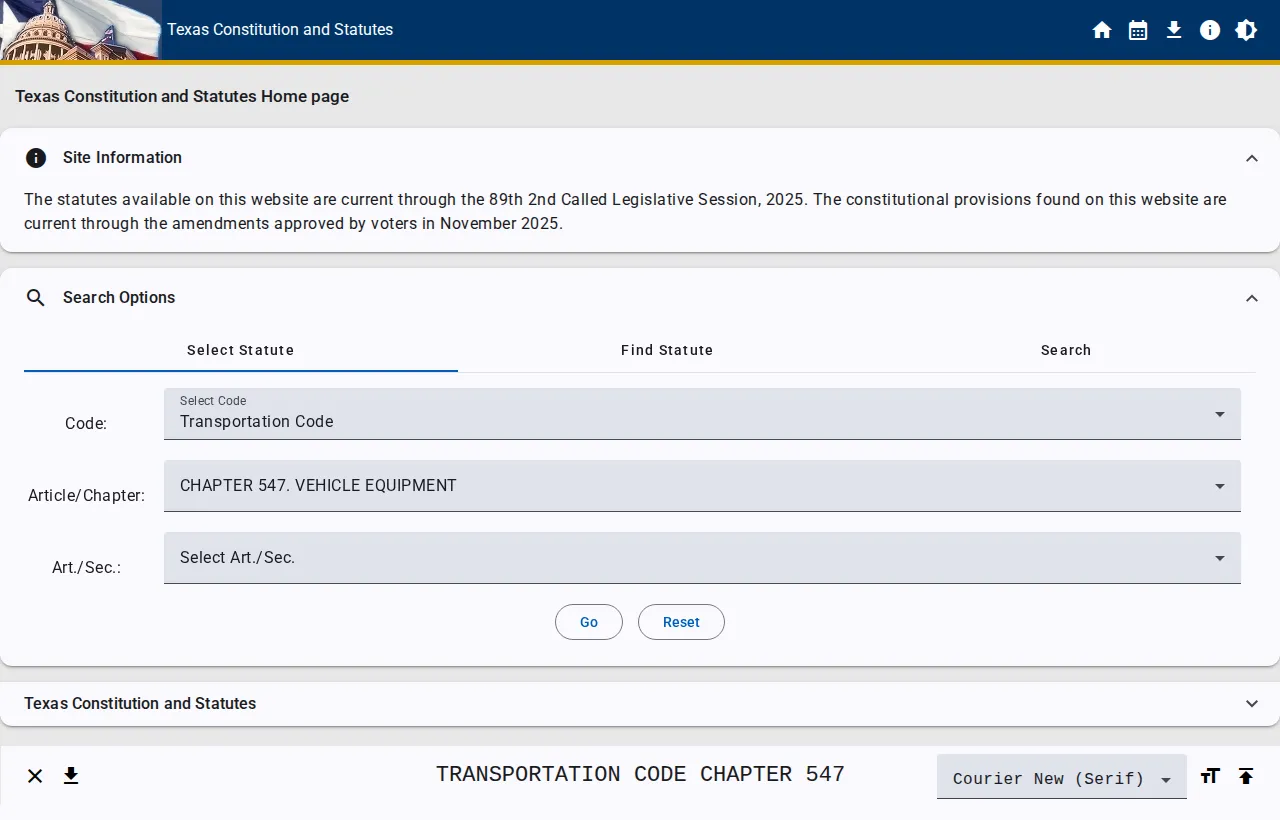
Verify on Texas Statutes Transportation Code Chapter 547. Send a correction if needed.
Nearby states & related laws
All 50 states →Oklahoma
Oklahoma train horn law (47 O.S. §12-401): vehicle horn rules, Oklahoma City / Tulsa enforcement, aftermarket horn regulations. Plain-English guide.
New Mexico
New Mexico train horn law (NMSA §66-3-843): vehicle horn rules, Albuquerque enforcement, aftermarket horn regulations. Plain-English guide.
Louisiana
Louisiana train horn law (La. R.S. §32:351): vehicle horn rules, New Orleans and Baton Rouge enforcement. Plain-English guide with statute citation.
Arkansas
Arkansas Code §27-37-202 covers vehicle horns. Install is not prohibited; unreasonably loud use is citable. Plain-English summary with official sources.
Continue on Train Horn
All 50 states
Full state-by-state legality index with statuses, citations, and decibel caps where defined.
Decibel distance calculator
Inverse-square-law tool that shows perceived loudness at any distance from the horn.
Battery-powered platforms
Horns organized by cordless-tool battery — Milwaukee M18, DeWalt 20V, Ryobi, Makita.
HornBlasters Shocker XL review
154 dB four-trumpet flagship kit — measured output, install notes, and verdict.
Sources & Citations
- [1] Texas Statutes — Transportation Code §547.501 (official)
- [2] Texas Transportation Code Chapter 547 (Vehicle Equipment)
- [3] Texas Transportation Code §542.401 — General Penalty (official)
Educational content. Not legal advice. Verify current statutes with your state DMV or a licensed attorney before installation.