
Disclaimer. This page summarizes publicly available Virginia statutes as of October 2026. Not legal advice. Verify and consult a licensed VA attorney.
- Legal status
- Legal
- Install not banned by name
- Statute
- §46.2-1060
- Va. Code Title 46.2
- Horn required
- Yes
- §46.2-1059 · audible 200 ft
- Specific dB cap
- None
- Officer-judged
- Siren ban
- §46.2-1060
- Sirens & whistles
- Penalty
- Traffic infraction
- §46.2-113 fine
Are train horns legal in Virginia?
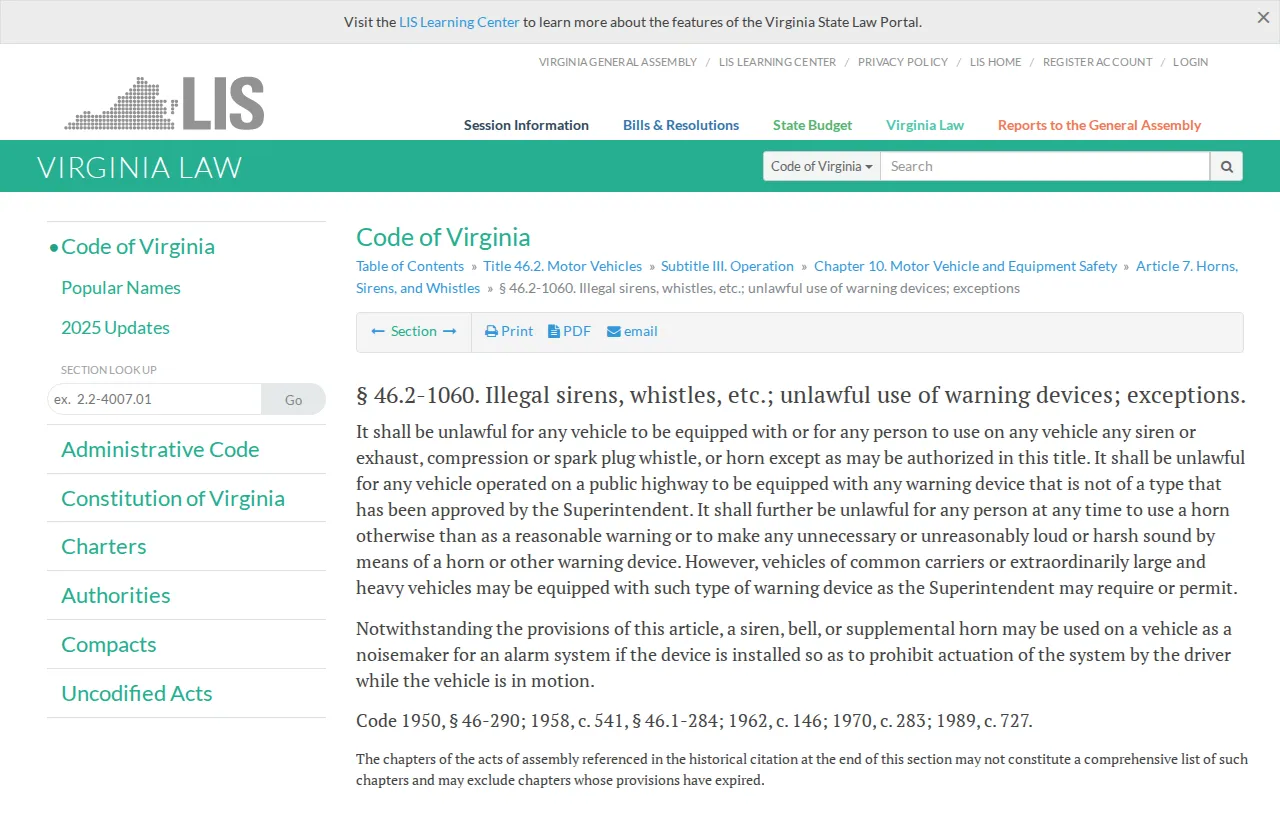
No Virginia statute names train horns, and none bans them by name. Virginia train horn law is in Va. Code §46.2-1060 — “Illegal sirens, whistles, etc.; unlawful use of warning devices; exceptions.” It bars any siren or “exhaust, compression or spark plug whistle, or horn except as may be authorized in this title,” requires every warning device on a vehicle operated on a public highway to be “of a type that has been approved by the Superintendent,” and makes it unlawful to use a horn “otherwise than as a reasonable warning.” The basic horn requirement is the separate §46.2-1059 — “Horns”: a working horn audible for at least 200 feet.
Install is not prohibited by name; use on VA public roads — Virginia Beach, Norfolk, Chesapeake, Arlington, Richmond, Newport News, Alexandria — is the regulated behavior. The approved-type rule is the main gray area (see below).
Updated 2026-10-24: corrected the statute citations and quotes. Earlier versions of this page quoted text for §46.2-1060 (“in good working order capable of emitting a sound sufficiently loud to serve as a warning…”) that does not appear in the Code of Virginia, said Virginia has no 200-foot audibility figure, and attributed the siren/whistle ban to §46.2-1061. In fact the 200-foot horn requirement is §46.2-1059, the siren/whistle ban and horn-use rule are §46.2-1060, and §46.2-1061 requires sirens on emergency vehicles. The legislative history of both sections shows a last amendment in 1989, so the law itself has not changed. The page’s status (“legal” to install) is unchanged pending editorial review of the approved-type requirement. Re-verified against the Virginia General Assembly’s official LIS Code of Virginia on 10/24/2026.
What Va. Code §46.2-1060 actually says
It shall be unlawful for any vehicle to be equipped with or for any person to use on any vehicle any siren or exhaust, compression or spark plug whistle, or horn except as may be authorized in this title. It shall be unlawful for any vehicle operated on a public highway to be equipped with any warning device that is not of a type that has been approved by the Superintendent. It shall further be unlawful for any person at any time to use a horn otherwise than as a reasonable warning or to make any unnecessary or unreasonably loud or harsh sound by means of a horn or other warning device. However, vehicles of common carriers or extraordinarily large and heavy vehicles may be equipped with such type of warning device as the Superintendent may require or permit. Notwithstanding the provisions of this article, a siren, bell, or supplemental horn may be used on a vehicle as a noisemaker for an alarm system if the device is installed so as to prohibit actuation of the system by the driver while the vehicle is in motion.
Every motor vehicle driven on a highway shall be equipped with a working horn capable of emitting sound audible under normal conditions for at least 200 feet.
Operative rules: working horn audible at 200 ft (§46.2-1059) · no siren or exhaust/compression/spark plug whistle unless authorized · warning devices on highway vehicles must be of a Superintendent-approved type · horn use only as a reasonable warning · no unnecessary or unreasonably loud or harsh sound · alarm-system exception for a supplemental horn the driver can’t trigger while moving (§46.2-1060).
Does the factory horn need to stay working in VA?
Yes. §46.2-1059 requires “a working horn” audible for at least 200 feet, and the Virginia State Police safety inspection rules reject a vehicle that “is not equipped with a horn in good working order, capable of emitting a sound audible under normal conditions over a distance of not less than 200 feet” (19VAC30-70-240).
Is a train horn a prohibited device under §46.2-1060?
- ·Siren (unless authorized)
- ·Exhaust, compression or spark plug whistle
- ·Warning device not of an approved type
- ·Unnecessary or unreasonably loud or harsh sound
- ·Multi-note air-compressor chord
- ·Not named in the statute
- ·Approved-type rule is the gray area
- ·Use limited to "reasonable warning"
Virginia prohibits “exhaust, compression or spark plug whistle[s].” The Code does not define those terms, and no statute names train horns. An air horn fed by its own compressor is not obviously a “whistle,” but an officer or court could read it differently.
The bigger question is the approved-type rule. §46.2-1060 makes it unlawful for a vehicle operated on a public highway to be equipped with a warning device “that is not of a type that has been approved by the Superintendent” (the Superintendent of State Police). Under §46.2-1002, equipment that “meets or exceeds the standards and specifications of the Society of Automotive Engineers, the American National Standards Institute, Incorporated or the federal Department of Transportation” also qualifies. Most aftermarket train horns are not marketed with Virginia approval or an SAE rating, so a horn that is wired up on a street-driven vehicle carries some equipment-violation risk even if you never sound it on the road.
Portable and battery-powered train horns in VA
§46.2-1059 and §46.2-1060 do not distinguish horns by power source. M18, DeWalt 20V, Ryobi, Makita portables fall under the same use rules when sounded from a vehicle.
Enforcement in practice
Virginia is moderately enforcing. Northern Virginia (Arlington, Fairfax, Alexandria) and Hampton Roads see more active enforcement; rural Southwest VA and Eastern Shore rarely cite.
Practical Virginia train horn compliance
- 01 Keep factory horn wired and working
§46.2-1059 requirement; checked at safety inspection.
- 02 Put the train horn on a separate switch
Distinct from OEM button.
- 03 Use factory horn for ordinary signaling
§46.2-1060 allows horn use only as a reasonable warning.
- 04 Reserve use for off-road / farms / private property
VA has substantial rural and mountain land.
- 05 Know the approved-type rule
A disconnect switch or removable horn lowers equipment-violation risk on street-driven vehicles.
- 06 Watch NoVA / Richmond / Hampton Roads ordinances
Municipal noise codes layer on state law.
- 07 Hearing protection when testing
140+ dB causes immediate damage.
How to verify this page
Verify on the Virginia General Assembly’s official Code of Virginia: §46.2-1060 and §46.2-1059. Send a correction if needed.
Nearby states & related laws
All 50 states →West Virginia
West Virginia train horn law (W. Va. Code §17C-15-33): vehicle horn rules, Charleston / Huntington enforcement, aftermarket horn regulations. Plain-English guide.
Maryland
Maryland train horn law (Md. Transp. §22-401): vehicle horn rules, Baltimore / DC metro enforcement, aftermarket horn regulations. Plain-English guide.
North Carolina
North Carolina train horn law (N.C.G.S. §20-125): vehicle horn rules, Charlotte / Raleigh enforcement, aftermarket horn regulations. Plain-English guide.
Tennessee
Tennessee train horn law (T.C.A. §55-9-201): vehicle horn rules, Nashville / Memphis enforcement, aftermarket horn regulations. Plain-English guide.
Continue on Train Horn
All 50 states
Full state-by-state legality index with statuses, citations, and decibel caps where defined.
Decibel distance calculator
Inverse-square-law tool that shows perceived loudness at any distance from the horn.
Battery-powered platforms
Horns organized by cordless-tool battery — Milwaukee M18, DeWalt 20V, Ryobi, Makita.
HornBlasters Shocker XL review
154 dB four-trumpet flagship kit — measured output, install notes, and verdict.
Sources & Citations
- [1] Va. Code §46.2-1060 — Illegal sirens, whistles, etc.; unlawful use of warning devices (Virginia LIS)
- [2] Va. Code §46.2-1059 — Horns (Virginia LIS)
- [3] Va. Code §46.2-1002 — Illegal possession or sale of certain unapproved equipment (Virginia LIS)
- [4] Va. Code §46.2-113 — Violations of this title; penalties (Virginia LIS)
- [5] 19VAC30-70-240 — Horns and other warning devices (VSP safety inspection rules)
- [6] Virginia DMV
Educational content. Not legal advice. Verify current statutes with your state DMV or a licensed attorney before installation.