Disclaimer. This page summarizes publicly available Massachusetts statutes as of August 2026 and is published for general informational purposes only. It is not legal advice, and nothing on this page creates an attorney–client relationship. Statutes change, enforcement is active in Boston and the Route-128 corridor, and individual circumstances matter — always verify the current text and consult a licensed Massachusetts attorney before making installation or use decisions.
- Legal status
- Mounted only
- Install tolerated, use restricted
- Statute
- c.90 §16
- M.G.L. Chapter 90
- Primary test
- No harsh / unreasonable
- Anti-noise framing
- Specific dB cap
- Registrar rules
- Set by RMV
- Safety inspection
- Yes
- Annual, checks horn
- Penalty
- Traffic violation
- Fine + possible points
Are train horns legal in Massachusetts? Short answer
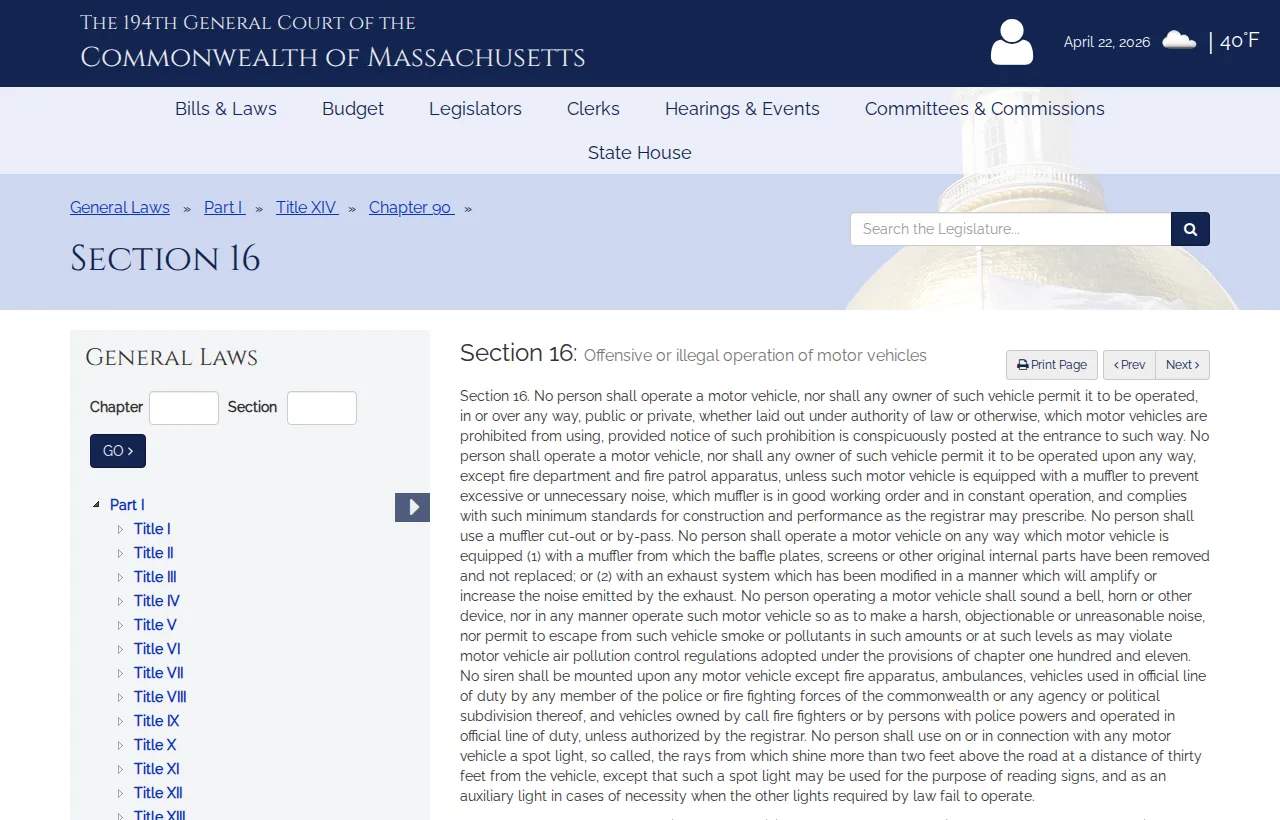
Massachusetts is a “mounted-only” jurisdiction in practice. Unlike most states’ horn statutes, Massachusetts folds the horn rule into a broader anti-noise provision: M.G.L. Chapter 90, Section 16 — “Offensive or illegal operation of motor vehicles.” The operative clause is that no person operating a motor vehicle shall sound a bell, horn, or other device, nor in any manner operate such motor vehicle so as to make a harsh, objectionable or unreasonable noise.
The statute also grants the Registrar of Motor Vehicles rulemaking authority over minimum horn-equipment standards. Combined with Massachusetts’s annual state vehicle safety inspection, this makes Massachusetts one of the more actively-regulated states for aftermarket audio.
What M.G.L. c.90 §16 actually says
No person operating a motor vehicle shall sound a bell, horn or other device, nor in any manner operate such motor vehicle so as to make a harsh, objectionable or unreasonable noise. No person shall operate a motor vehicle, nor shall any owner of such vehicle permit it to be operated upon any way, except fire department and fire patrol apparatus, unless such motor vehicle is equipped with a muffler to prevent excessive or unnecessary noise, which muffler is in good working order and in constant operation, and complies with such minimum standards for construction and performance as the registrar may prescribe.
Operative rules:
- No driver may sound a horn (or operate the vehicle) in a manner that makes a “harsh, objectionable or unreasonable noise” — the phrase is broader than other UVC states.
- Mufflers and exhaust systems are regulated in the same section with the Registrar’s minimum standards.
- Enforcement is at RMV standards, not a fixed statutory dB cap.
- Annual state inspection verifies horn function and muffler condition.
Does the factory horn need to stay working in Massachusetts?
Yes — and Massachusetts actively verifies it. The state’s annual vehicle safety inspection includes horn function as a pass/fail item. A disconnected or inoperative factory horn is a fail at inspection — blocking registration renewal until corrected.
Keep the factory horn wired to its OEM button; install the train horn on a separate dedicated switch.
What counts as “harsh, objectionable or unreasonable” under §16?
- ·Broader than pure "unreasonably loud" UVC states
- ·Includes "objectionable" — a subjective-complaint hook
- ·Registrar sets enforceable minimums for equipment
- ·Enforcement: officer judgment + RMV rules
- ·Install itself not banned by §16
- ·Use can be cited as "harsh or objectionable"
- ·Factory horn function checked at annual inspection
- ·Municipal noise ordinances layer on state law
Portable and battery-powered train horns in Massachusetts
§16 regulates the operation of a motor vehicle in a way that makes harsh or unreasonable noise. Portable train horns on Milwaukee M18, DeWalt 20V, Ryobi ONE+, and Makita LXT platforms are subject to the same test when used on or from a public Massachusetts road.
Enforcement in practice
Massachusetts is actively enforcing. Boston PD, State Police, and local departments in Cambridge, Somerville, Newton, Brookline, Quincy, Worcester, and Springfield routinely cite modified-vehicle noise equipment. Annual safety inspection provides an additional compliance checkpoint.
Practical Massachusetts train horn compliance
- 01 Keep the factory horn wired and working
Non-negotiable. Mass annual inspection verifies horn function. A failed sticker blocks registration renewal.
- 02 Put the train horn on a covered or keyed switch
Shows the train horn is not the primary signaling device and helps at inspection.
- 03 Do not use on public Mass. roads
§16's 'harsh, objectionable or unreasonable' standard is broader than UVC and actively enforced.
- 04 Reserve use for off-road / events / private property
Massachusetts has off-highway recreation areas, farms, closed courses — the practical use pattern.
- 05 Watch local city ordinances
Boston c.16 §12, Cambridge, Somerville, Newton all have separate noise codes that layer on the state law.
- 06 Hearing protection when testing
140+ dB causes immediate damage at close range.
How to verify this page
Massachusetts General Laws sections can be amended. Before acting on anything here, verify the current text of c.90 §16 on the Massachusetts Legislature’s official General Laws portal and consult a licensed Massachusetts attorney for your specific situation. If you notice this page is out of date, please send a correction — we update within 48 hours when a cited source is provided.
Nearby states & related laws
All 50 states →Connecticut
Connecticut General Statutes §14-80 and §14-80a govern vehicle horns and noise. Install permitted; use is tightly limited by state noise rules. Plain summary.
Rhode Island
Rhode Island train horn law (R.I. Gen. Laws §31-23-8): vehicle horn rules, Providence / Warwick enforcement, aftermarket horn regulations. Plain-English guide.
New Hampshire
New Hampshire train horn law (RSA 266:54): horn requirement, Manchester / Concord enforcement, aftermarket horn regulations. Plain-English guide.
New York
New York train horn law (NY VTL §375(1)): vehicle horn rules, NYC enforcement, aftermarket horn regulations. Plain-English guide with statute citation.
Continue on Train Horn
All 50 states
Full state-by-state legality index with statuses, citations, and decibel caps where defined.
Decibel distance calculator
Inverse-square-law tool that shows perceived loudness at any distance from the horn.
Battery-powered platforms
Horns organized by cordless-tool battery — Milwaukee M18, DeWalt 20V, Ryobi, Makita.
HornBlasters Shocker XL review
154 dB four-trumpet flagship kit — measured output, install notes, and verdict.
Sources & Citations
- [1] Massachusetts Legislature — M.G.L. c.90 §16 (official portal)
- [2] Massachusetts General Laws Chapter 90 (index)
- [3] FindLaw — M.G.L. c.90 §16 (annotated)
Educational content. Not legal advice. Verify current statutes with your state DMV or a licensed attorney before installation.