
Disclaimer. This page summarizes publicly available New York statutes and NYC regulations as of September 2026 and is published for general informational purposes only. It is not legal advice. NY and NYC enforcement is active — verify the current text and consult a licensed New York attorney.
- Legal status
- Restricted
- Active NY + NYC enforcement
- Statute
- VTL §375(1)
- Vehicle & Traffic Law
- Horn required
- Yes
- "Suitable and adequate"
- Primary test
- Reasonable warning
- Not "unnecessarily loud or harsh"
- NYC overlay
- Air horn ban
- Admin. Code §24-237(b)
- Penalty
- Summons
- Fine + possible points
Are train horns legal in New York? Short answer
New York is a restricted state for aftermarket train horns, with NYC adding a second layer of strict noise regulation. The state-level New York train horn law is in NY VTL §375(1) — “Equipment.” Every motor vehicle must be provided with “a suitable and adequate horn or other device for signaling” that produces “a sound sufficiently loud to serve as a danger warning but shall not be used other than as a reasonable warning nor be unnecessarily loud or harsh.”
Two further provisions matter and are easy to miss. VTL §375(26) bars a “gong or siren whistle” on any vehicle other than an authorized emergency vehicle. And inside the five boroughs, NYC Administrative Code §24-237(b) separately prohibits the unauthorized use of a motor-vehicle air horn — which is what a train horn is. Install is not itself expressly banned by the state; use on NYC streets is both separately illegal and aggressively policed.
What NY VTL §375(1) actually says
Every motor vehicle operated or driven upon the public highways of the state shall be provided with a suitable and adequate horn or other device for signaling, which horn or device shall produce a sound sufficiently loud to serve as a danger warning but shall not be used other than as a reasonable warning nor be unnecessarily loud or harsh.
The same section separately restricts siren-type devices:
A gong or siren whistle shall not be used on any vehicle other than an authorized emergency vehicle. This shall not be construed to apply to a gong or siren designed and used solely as a burglar alarm on a vehicle.
Updated 2026-09-19: the §375(1)(a) text above was re-verified character-for-character against the New York Senate’s official VTL portal and is unchanged. Two additions were made this pass. First, the horn sentence sits in paragraph (a) of subdivision 1, so the precise cite is §375(1)(a); earlier versions cited only §375(1). Second, earlier versions of this page omitted §375(26) entirely — see the caveat below on how much weight it carries for train horns. The page’s status (“restricted”) is unchanged.
Operative rules:
- Every motor vehicle must have “a suitable and adequate horn” on public highways.
- Horn must produce a sound sufficiently loud to serve as a danger warning — but no specific 200-ft standard.
- Horn “shall not be used other than as a reasonable warning” — usage-limitation clause.
- Horn “shall not be unnecessarily loud or harsh” — loudness-limitation clause.
- §375(26) separately bars a “gong or siren whistle” on any non-emergency vehicle.
- NYC overlay: Admin. Code §24-237(b) prohibits unauthorized use of a motor-vehicle air horn outright — this is a flat prohibition, not a decibel cap.
Does the factory horn need to stay working in New York?
Yes. VTL §375(1) requires a “suitable and adequate” horn on every motor vehicle. Disconnecting the factory horn is an equipment violation. NY also conducts an annual safety inspection, and the horn is an explicitly listed item — the DMV’s inspection checklist directs the inspector to “check mounting and operation.”
Is a train horn a prohibited “unnecessarily loud or harsh” sound?
- ·Broader than UVC "unreasonably loud" test
- ·Covers both loudness and tonal quality
- ·Enforcement via officer judgment
- ·NYC Admin. Code §24-237(b) bans air-horn use outright
- ·Install itself not expressly banned
- ·BUT use on NY public roads almost certainly triggers §375(1) violation
- ·NYPD and NYSP actively enforce
- ·NYC has dedicated noise-enforcement units
How much does §375(26) actually add?
Be careful here, because this is the point most summaries get wrong in one direction or the other. §375(26) speaks to a “gong or siren whistle,” not to horns generally. A multi-trumpet air train horn is not obviously a gong or a siren, and we are not aware of a published New York decision applying §375(26) to a train horn. So this page does not claim that §375(26) bans train horns statewide.
What it does mean practically: if a device is set up to imitate an emergency siren, §375(26) is the provision an officer will reach for, and it is a separate chargeable violation on top of §375(1)(a). Treat it as added exposure, not as the main rule. The main state-level rule for a train horn remains the “reasonable warning” and “unnecessarily loud or harsh” clauses of §375(1)(a).
Portable and battery-powered train horns in New York
VTL §375(1) applies to any “horn or other device for signaling” regardless of power source. Portable horns on Milwaukee M18, DeWalt 20V, Ryobi ONE+, and Makita LXT platforms fall under the same rules.
NYC Noise Code (Title 24, Chapter 2) — the second layer
If you drive in the five boroughs, this is the layer that actually matters, and it is stricter than the state rule. NYC Administrative Code §24-237 (“Sound signal devices”) deals with horns directly, and subsection (b) covers the exact device this site is about: it prohibits the unauthorized use of an air horn or gong installed on a motor vehicle, outside the narrow exception in §24-241.
That is the correction worth internalizing: for horns, the NYC rule is a flat prohibition, not a decibel limit. There is no dB number you can stay under to make a train horn legal to sound on a New York City street. The code’s decibel-based vehicle standards live in a different section — §24-236, which governs excess exhaust/engine noise and drives the city’s noise-camera program — and they are not the provision that a train horn gets written up under.
The penalties are not nominal. From the city’s official Noise Code Penalty Schedule (Admin. Code §31-115):
| Violation | 1st offense | 2nd | 3rd |
|---|---|---|---|
| §24-237(b) — unauthorized use of motor vehicle air horn/gong | $350 | $700 | $1,050 |
| §24-237(a) — unauthorized use of motor vehicle claxon (standard horn) | $350 | $700 | $1,050 |
Those are the minimum admitted penalties; the schedule’s default penalties (what you owe if you ignore the summons) run to $2,625 for a third §24-237(b) offense and $3,000 for a third §24-237(a) offense. Note that even ordinary non-emergency honking on a standard factory horn is a $350 ticket in NYC under §24-237(a).
Enforcement is real and complaint-driven:
- NYPD responds to noise complaints; NYC DEP has dedicated noise inspectors who write §24-237 summonses.
- 311 is the front door — any resident can file a noise complaint online or by phone, and it generates a service request that gets followed up.
- DEP also runs an automated noise-camera program, though that is aimed at §24-236 exhaust noise rather than horns.
A train horn used even once in residential NYC can produce a 311 complaint and a follow-up citation.
Enforcement in practice
New York is actively enforcing at both state and city levels. NYSP Troop T (Thruway), municipal departments in Buffalo, Rochester, Syracuse, Albany, Yonkers, NYC’s five boroughs all regularly cite horn and noise violations. Rural upstate NY is less active, but Adirondack and Catskill region enforcement still happens on complaint.
Practical New York train horn compliance
- 01 Keep the factory horn wired and functional
Non-negotiable — checked at annual inspection and during stops.
- 02 Use a covered / keyed switch
Documents that the train horn is not a primary signaling device.
- 03 Do NOT use on NY public roads
Statewide this is a §375(1)(a) judgment call; inside NYC, sounding an air horn is flatly prohibited by §24-237(b) — there is no dB threshold that makes it legal.
- 04 Reserve use for off-road / events / private property
Upstate farm land, closed courses, Thunder Ridge / Holiday Mountain events, private property.
- 05 Understand NYC 311 system
Any horn use in NYC can trigger a 311 noise complaint that gets inspected.
- 06 Hearing protection when testing
140+ dB causes immediate damage.
How to verify this page
Last re-verified 09/19/2026. VTL sections can be amended, so check the text yourself before relying on it.
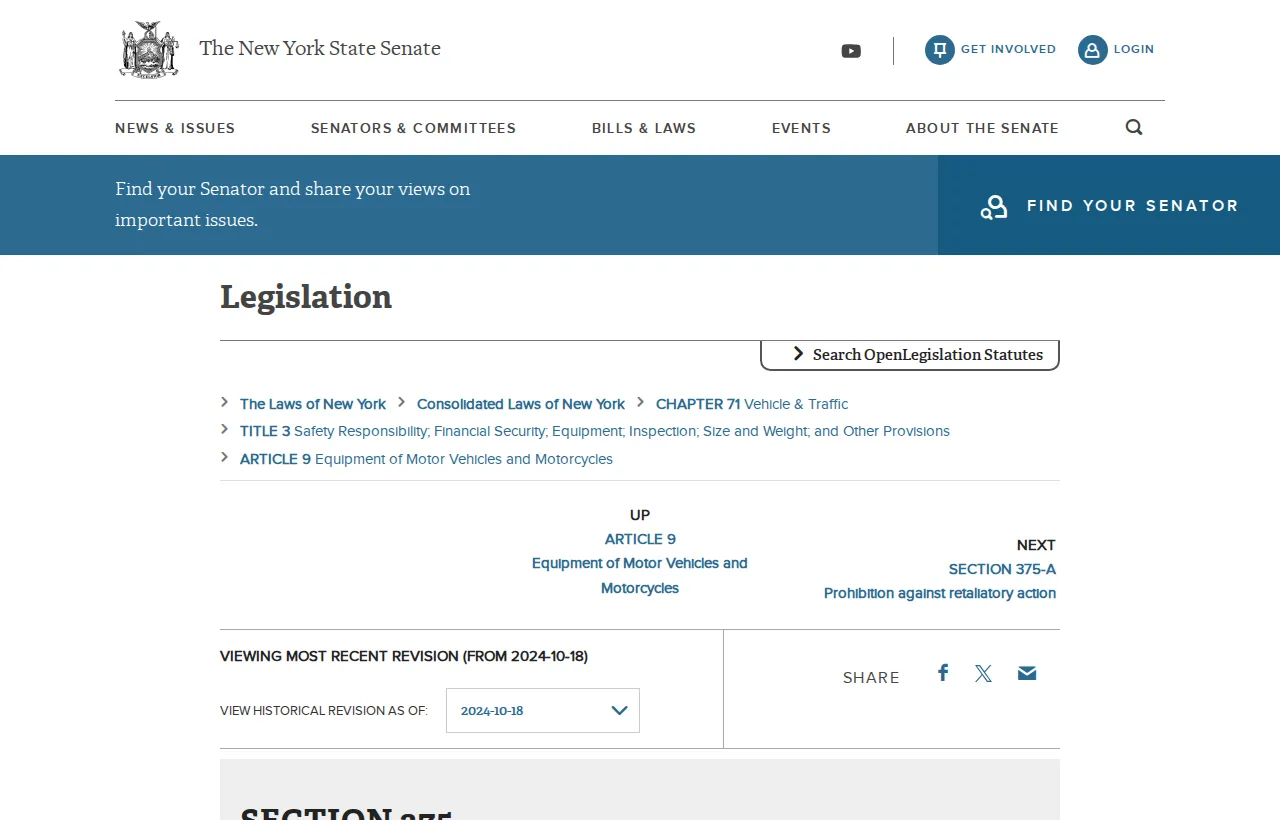
- State statute — New York Senate’s official VTL §375 portal (subdivision 1(a) for the horn rule, subdivision 26 for gongs and sirens).
- NYC Noise Code — official NYC DEP noise-code portal.
- NYC penalties — Admin. Code §31-115 Noise Code Penalty Schedule (DEP PDF), the source of the §24-237 fine figures above.
- Inspection — NY DMV safety inspection equipment items, which lists the horn.
Consult a licensed New York attorney. Send a correction if needed.
Nearby states & related laws
All 50 states →New Jersey
New Jersey train horn law (N.J.S.A. 39:3-69): vehicle horn rules, active NJ enforcement, aftermarket horn regulations. Plain-English guide.
Connecticut
Connecticut General Statutes §14-80 and §14-80a govern vehicle horns and noise. Install permitted; use is tightly limited by state noise rules. Plain summary.
Pennsylvania
Pennsylvania train horn law (75 Pa.C.S. §4535): vehicle horn rules, Philadelphia / Pittsburgh enforcement, aftermarket horn regulations. Plain-English guide.
Massachusetts
Massachusetts train horn law (M.G.L. c.90 §16): horn noise rules, Boston enforcement, aftermarket horn regulations. Plain-English guide with citations.
Continue on Train Horn
All 50 states
Full state-by-state legality index with statuses, citations, and decibel caps where defined.
Decibel distance calculator
Inverse-square-law tool that shows perceived loudness at any distance from the horn.
Battery-powered platforms
Horns organized by cordless-tool battery — Milwaukee M18, DeWalt 20V, Ryobi, Makita.
HornBlasters Shocker XL review
154 dB four-trumpet flagship kit — measured output, install notes, and verdict.
Sources & Citations
- [1] New York Senate — VTL §375 (official portal)
- [2] NYC DEP — Noise Code (official portal)
- [3] NYC Admin. Code §31-115 — Noise Code Penalty Schedule (official DEP PDF)
- [4] NY DMV — Safety inspection equipment items (horn)
- [5] VTL §375 — Equipment (Justia)
Educational content. Not legal advice. Verify current statutes with your state DMV or a licensed attorney before installation.