Train Horn Trumpet Material: ABS vs Aluminum vs Zinc vs Brass
ABS composite, cast aluminum, zinc alloy or brass? How each train horn trumpet material compares on weight, corrosion, cost and sound, with real horn examples.
Train horn trumpet material shows up in every product title, from “heavy-duty zinc alloy” to “fiberglass-reinforced ABS” to “chromed brass.” It matters a lot for weight, corrosion, and how long the horn looks good, and a lot less for how loud it is than most listings suggest. Here is how the four common materials actually compare, with real products for each.
The quick comparison
Each material’s density comes from its Wikipedia materials entry. The example horns and their specs come from the manufacturer and retailer pages listed in Sources.
| Material | Density (g/cm³) | Typical finish | Main enemy | Example horns |
|---|---|---|---|---|
| ABS / fiberglass-reinforced ABS | 1.06–1.08 | Molded black or white, sometimes chrome-look | UV and heat | HornBlasters Shocker XL, Kleinn 230 |
| Cast aluminum | 2.70 | Raw casting or powder coat | Salt, and contact with dissimilar metals | Nathan AirChime K5LA, Leslie RS-3L |
| Zinc alloy (zamak) | about 6.7 | Chrome plate or powder coat | Plating failure | United Pacific 46129, most budget chrome kits |
| Brass | 8.4–8.73 | Chrome plate or polished | Tarnish, chlorides, dezincification | Grand General 69991 |
Look at the density column first. Brass is roughly eight times as dense as ABS, and zinc alloy is about two and a half times as dense as aluminum. For the same bell shape and wall thickness, that difference goes straight into your bracket, your fasteners, and whatever panel you bolt the horn to.
ABS and fiberglass-reinforced ABS composite
ABS is the same plastic family used for LEGO bricks, automotive trim, and even some trombones and clarinets. Wikipedia lists a normal service range of -4°F to 176°F (-20°C to 80°C) and notes that its impact resistance doesn’t drop off quickly in the cold. That matters on a truck that sees January mornings in Minnesota.
Not all “ABS” horns are the same, though. HornBlasters builds the Shocker XL from fiberglass-reinforced ABS with stainless steel internals and brass hardware, according to its product page. The four bells measure 19.50”, 16.25”, 14.75” and 12.75”, and the whole horn weighs 4.5 lb. The Shocker S6 uses the same composite and is listed at the same 4.5 lb. HornBlasters puts a lifetime manufacturer’s-defect warranty on the horns and a 2-year warranty on the other kit parts.
Kleinn’s Model 230 “Beast” shows the most common hybrid design: composite black ABS trumpets (18.5”, 16.5” and 14.5”) on heavy-duty zinc alloy drivers. Kleinn rates it at 155.1 dB at 150 PSI and lists it at $249.95. The plastic takes the shape and the weather, and the metal driver handles the diaphragm and the air connection.
- Lightest option by far, which is easy on brackets and bumpers
- Can’t rust, and doesn’t pit the way plated metal does
- Stays tough in cold weather
- Reinforced composites come with some of the longest warranties in the category
- UV light and heat cause photo-oxidation, so unprotected ABS can yellow and turn brittle over time
- Chrome-look coatings on cheap plastic bells are thin and scratch through easily
- Budget “ABS” kits rarely say whether the plastic is reinforced
If you already own chrome-look plastic bells, our trumpet cleaning and restoration guide covers what you can and can’t safely polish.
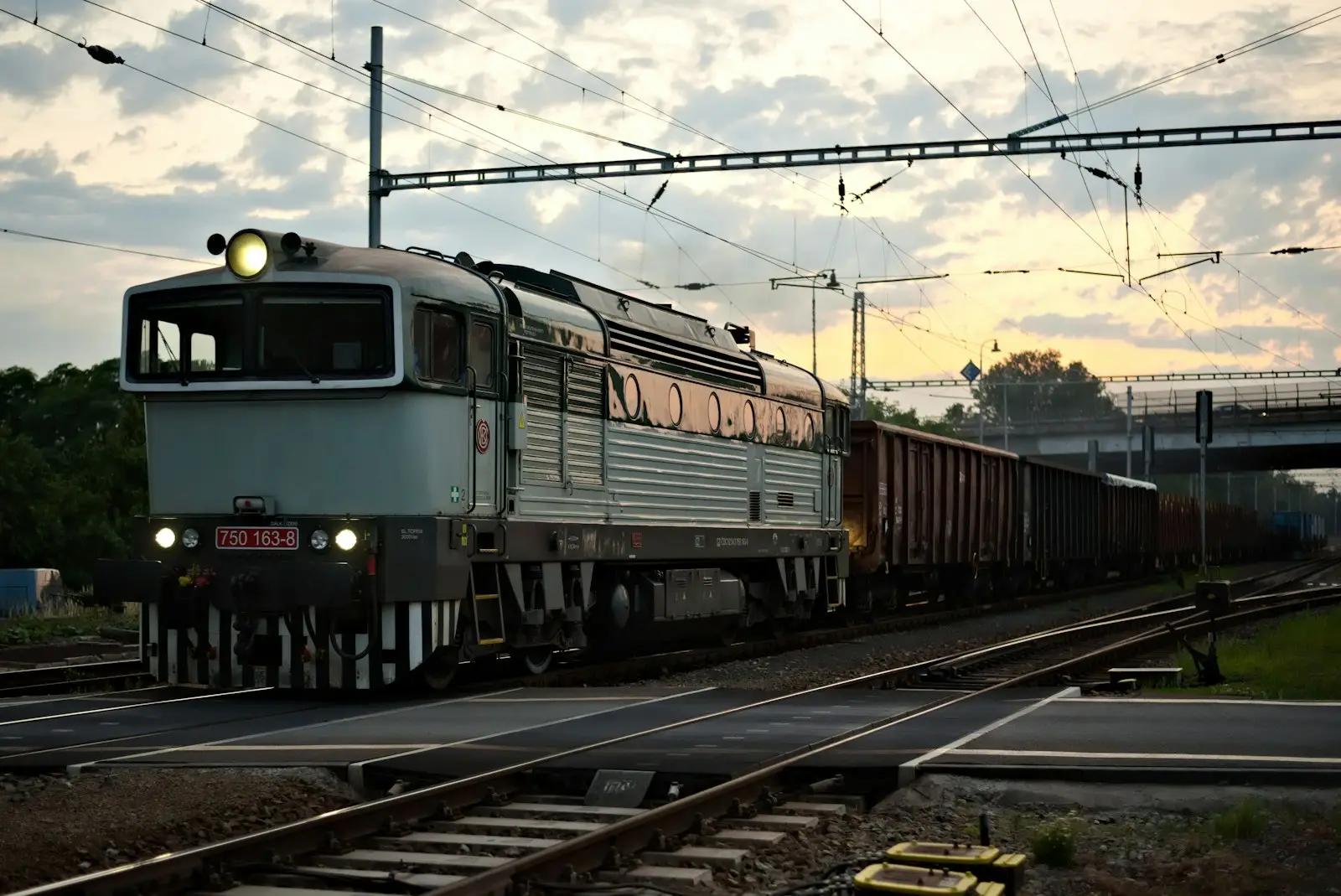
Cast aluminum: what real locomotive horns are made of
Here’s what surprises a lot of buyers: the classic locomotive horns aren’t brass. HornBlasters describes the Nathan AirChime K5LA as five die-cast aluminum bells with stainless steel diaphragms, and it describes the Leslie RS-3L as having a die-cast aluminum body. According to Wikipedia’s Nathan Manufacturing history, early K-series horns were sand-cast and later ones were die-cast.
Aluminum works on a locomotive because it protects itself. Per Wikipedia, it forms a thin oxide layer (about 5 nm at room temperature) that blocks further corrosion from oxygen and water. Chlorides can break that layer down, though, and road salt is a chloride.
The other catch is weight. Because these horns are cast thick for railroad duty, they’re heavy even though aluminum itself is a light metal. HornBlasters lists the K5LA at 37 lb and the RS-3L at 25 lb. Mounting either one takes a real bracket, not a pair of self-tappers. Our Nathan K5LA review and Leslie RS-3L review cover mounting in detail.
- The authentic locomotive material, with a proven service record on real trains
- Self-protecting oxide layer, and powder coat bonds well
- Thick castings hold up to vibration and debris
- Heavy in real-horn form: 25 to 37 lb for the examples above
- Expensive: HornBlasters lists the reconditioned K5LA at $4,499.99 and the RS-3L at $2,849.99 at publication
- Salt and dissimilar-metal fittings can cause corrosion (see below)
Zinc alloy: the chrome kit workhorse
When a budget listing says “heavy-duty metal,” it almost always means zinc alloy, usually the zamak family. Per Wikipedia, zamak alloys are zinc with about 4% aluminum, and zamak 3 alone accounts for more than 70% of North American zinc die castings. Zamak also electroplates well, and that’s the whole point here: it’s the cheapest way to make a shiny chrome trumpet.
Real examples show the pattern. One retailer lists the United Pacific 46129 three-trumpet horn as “zinc alloy with chrome plating,” rated at 145 dB ±10 dB, at $152.24 with a 12.1 lb package weight. United Pacific’s 4-trumpet mini kit (09-051366K) is listed as chrome-plated zinc alloy, rated at 130 dB ±10 dB, with a 5.5-liter tank, at $337.99. A ±10 dB tolerance tells you very little, and we cover why in our review of the 46129.
- Cheap to cast into complex shapes, so you get a lot of chrome for the money
- Takes plating and powder coat well
- More rigid and dent-resistant than thin plastic
- At about 6.7 g/cm³, it’s heavy for its size
- Its looks depend entirely on the plating. Once chrome chips or pits, the exposed zinc underneath corrodes
- Budget zinc kits usually come with the loosest dB claims in the category
Stainless steel is worth a brief mention here because it often shows up alongside zinc. Kleinn lists its Model 730 “Demon” as stainless steel and zinc alloy construction, rated 157.8 dB at 150 PSI, at $599.95 with a 2-year warranty. See our Kleinn Demon 730 review if that’s the tier you’re shopping.
Brass: the heaviest and the most traditional
Brass is copper plus zinc. It’s the metal of trumpets and tubas because, per Wikipedia, it is malleable, easy to work, and reasonably corrosion-resistant. In train horn kits, it mostly shows up as fittings and solenoid bodies, but some horns use brass trumpets. The Grand General 69991 is listed with chromed brass trumpets on stainless steel brackets, rated at 140+ dB across a 70 to 140+ PSI range, at $275.
That wide pressure range makes it worth a look on semis with stock air systems. More on that in our Grand General 69991 review.
- Durable, easy-to-repair metal with a long history in horns and instruments
- Chrome-plated brass is a premium show finish
- Works on modest air pressure in the example above
- Densest material here at 8.4 to 8.73 g/cm³
- Per Wikipedia, it corrodes with moisture and chlorides, and dezincification (zinc leaching out of the alloy) is a known problem in marine settings
- Bare brass tarnishes brown or green unless it’s plated or polished regularly
Does trumpet material change the sound?
Only a little, and far less than bell length, flare, and air supply. One key study on this is by Kausel, Zietlow and Moore, published in the Journal of the Acoustical Society of America in 2010. They measured a trumpet with its bell heavily damped and then vibrating freely. They found that wall vibrations do affect the sound, but the effect is most significant in flaring sections. In cylindrical tubing, damping the walls normally produced no measurable effect.
For a train horn, that points one way. The material of the flared bell can slightly color the tone, but loudness comes from geometry, pressure, and flow. If you want more volume, our explainer on why some train horns are louder than others is the place to start. The pitch of each trumpet is set by its length, not its material, as our chord and trumpet tuning guide explains.
How to choose
- Road salt or coastal air: Fiberglass-reinforced ABS is the safest choice, because there’s no plating to fail and no metal to corrode. Powder-coated aluminum is a good second.
- Mounting to a thin panel or a small bracket: Choose ABS. A 4.5 lb composite horn and a 37 lb cast horn need very different mounting hardware.
- Chrome show finish on a budget: Choose zinc alloy, but plan on waxing it and expect to replace it once the plating goes.
- Authentic locomotive horn: Choose cast aluminum, and budget for the bracket as well as the horn.
- Semi with a stock air system: Brass or zinc horns that list a low minimum PSI are worth a look.
One install tip applies to every metal horn. Per Wikipedia’s galvanic corrosion entry, aluminum in contact with stainless steel corrodes quickly when salt water is present. Keeping the metals electrically separated, or sealing them with paint or another coating, prevents it. When you thread brass fittings into an aluminum manifold, use thread sealant and keep the joint dry and painted. Number of trumpets matters more to the sound than material, and our single vs dual vs quad trumpet comparison covers that choice.
Keep reading
- Why some train horns are louder than others
- Single vs dual vs quad trumpet train horns
- Why train horns make a chord: tuning and harmonics
- How to clean and restore train horn trumpets
- HornBlasters Shocker XL review
Sources
- HornBlasters — Shocker XL Train Horn product page — fiberglass-reinforced ABS, stainless and brass construction; 4.5 lb weight; 19.50/16.25/14.75/12.75 in bells; 150 PSI max; lifetime horn warranty and 2-year kit warranty
- HornBlasters — Shocker S6 product page — fiberglass-reinforced ABS composite with stainless internals; 4.5 lb weight
- HornBlasters — Nathan AirChime K5LA product page — die-cast aluminum bells, stainless diaphragms, 37 lb weight, $4,499.99 price, reconditioned with powder coat
- HornBlasters — Leslie RS-3L product page — die-cast aluminum body, 25 lb weight, $2,849.99 price
- Kleinn — Model 230 “Beast” ABS triple train horn — composite ABS trumpets on zinc alloy drivers, 18.5/16.5/14.5 in lengths, 155.1 dB at 150 PSI, $249.95
- Kleinn — Model 730 “Demon” triple train horn — stainless steel and zinc alloy construction, 157.8 dB at 150 PSI, $599.95, 2-year warranty
- Milian Truck Center — United Pacific 46129 listing — chrome-plated zinc alloy, 145 dB ±10 dB, $152.24, 12.1 lb package weight
- 4 State Trucks — United Pacific 4-trumpet mini train horn kit (09-051366K) — chrome-plated zinc alloy, 130 dB ±10 dB, 5.5 L tank, $337.99
- Horse & Buggy Chrome — Grand General 69991 listing — chromed brass trumpets, stainless brackets, 140+ dB, 70–140+ PSI, $275
- Wikipedia — Acrylonitrile butadiene styrene — ABS density, -4°F to 176°F service range, cold impact performance, UV yellowing and brittleness, instrument uses
- Wikipedia — Aluminium — 2.70 g/cm³ density, protective oxide layer about 5 nm thick, vulnerability to chlorides
- Wikipedia — Zamak — zinc with 4% aluminum, zamak 3 density of 6.7 g/cm³, more than 70% of North American zinc die castings, plates well
- Wikipedia — Brass — copper-zinc composition, 8.4–8.73 g/cm³ density, instrument use, corrosion and dezincification
- Wikipedia — Galvanic corrosion — aluminum corrosion in contact with stainless steel when salt water is present, prevention by insulation and coatings
- Wikipedia — Nathan Manufacturing — early K-series horns were sand-cast and later ones die-cast
- Kausel, Zietlow & Moore, “Influence of wall vibrations on the sound of brass wind instruments,” JASA 128(5), 2010 — wall vibration effects are most significant in flaring sections, with no measurable effect in cylindrical pipes
Frequently asked questions
Quick answers to the questions people ask most about this topic.
- Are real locomotive train horns made of brass?
- The classic ones aren't. HornBlasters describes the Nathan AirChime K5LA as five die-cast aluminum bells with stainless steel diaphragms, and it describes the Leslie RS-3L as having a die-cast aluminum body. Brass shows up more often in fittings, solenoids, and some aftermarket chrome horns like the Grand General 69991.
- Is an ABS plastic train horn as loud as a metal one?
- It can be. Loudness comes mainly from bell geometry, air pressure, and flow, not wall material. Kleinn rates its ABS-trumpet Model 230 at 155.1 dB at 150 PSI. Acoustics research published in JASA in 2010 found that wall vibrations matter mainly in flared sections, with no measurable effect in cylindrical tubing.
- Which train horn material is best for road salt or coastal areas?
- Fiberglass-reinforced ABS is the safest choice because it can't rust and has no plating to fail. Aluminum is protected by a natural oxide layer, but chlorides can break that layer down. Chrome-plated zinc alloy corrodes once the plating chips.
- What is zinc alloy on a train horn?
- It's usually zamak, a die-casting alloy of zinc with about 4% aluminum and a density of around 6.7 g/cm³. It's cheap to cast and electroplates well, which is why most budget chrome trumpets, like the United Pacific 46129, are made from it.
- How much does a train horn weigh by material?
- The spread is large. HornBlasters lists its fiberglass-reinforced ABS Shocker XL at 4.5 lb, its die-cast aluminum Leslie RS-3L at 25 lb, and its Nathan K5LA at 37 lb. By density alone, brass is roughly eight times as dense as ABS.
Related reviews & guides
Steel vs Aluminum vs Stainless Air Tanks for Train Horns
Single vs Dual vs Quad Trumpet Train Horns: Which to Buy?
HornBlasters vs Vixen Horns: Turnkey Kits vs Budget Trumpets

Manifold vs Individual-Bell Train Horns: Fitment, Sound & Plumbing

Nathan vs Leslie Train Horns: Which Locomotive Horn Sounds Better?