Disclaimer. This page summarizes publicly available Maine statutes as of August 2026 and is published for general informational purposes only. It is not legal advice, and nothing on this page creates an attorney–client relationship. Statutes change, enforcement varies between Portland and rural Maine, and individual circumstances matter — always verify the current text and consult a licensed Maine attorney before making installation or use decisions.
- Legal status
- Legal
- Install permitted
- Statute
- 29-A §1903
- Title 29-A Ch. 17
- Horn required
- Yes
- Adequate signaling device
- Specific dB cap
- None
- Unnecessary-use test
- Siren ban?
- Yes
- Emergency vehicles exempt
- Penalty
- Traffic violation
- Civil fine
Are train horns legal in Maine? Short answer
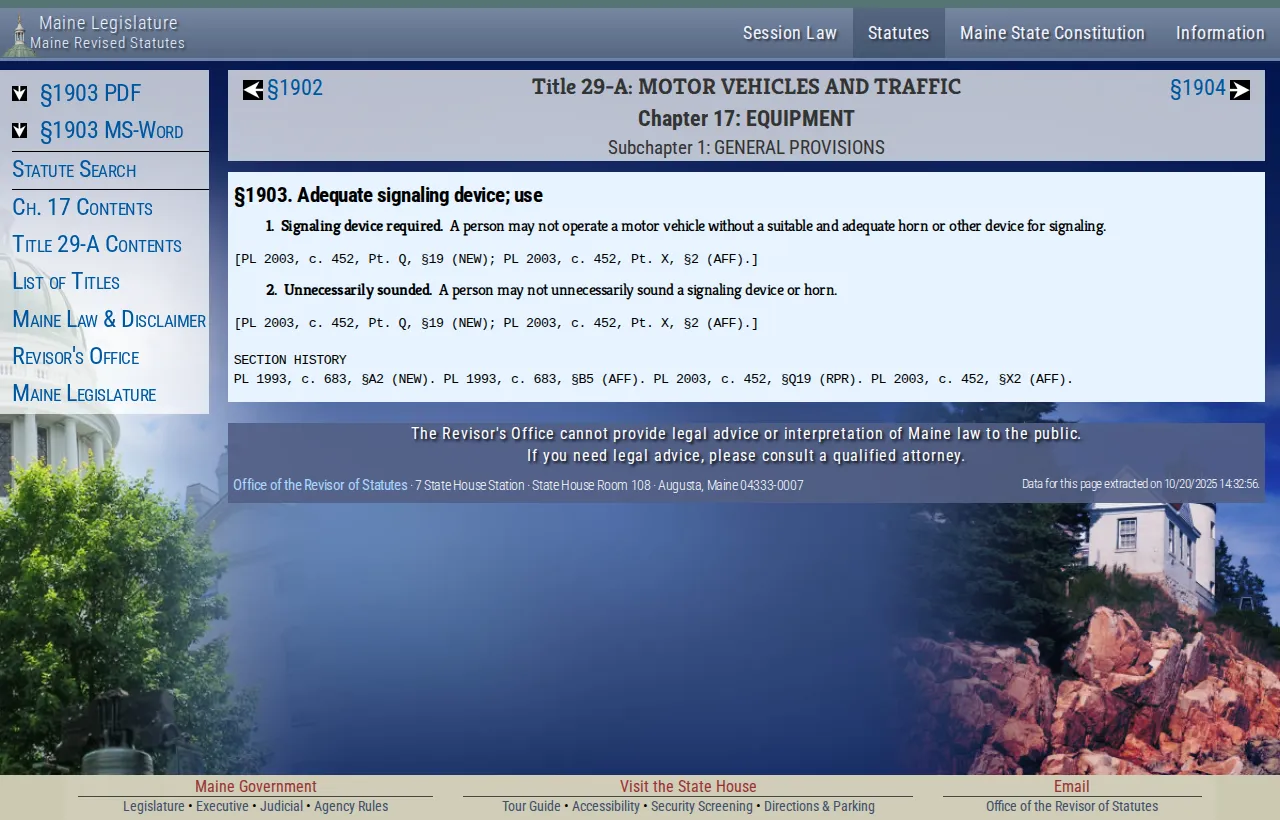
Installing an aftermarket train horn on a private vehicle in Maine is not prohibited. Maine’s horn law sits in 29-A M.R.S. §1903 (Adequate signaling device; use) within Chapter 17 (Equipment). It does exactly two things: a person “may not operate a motor vehicle without a suitable and adequate horn or other device for signaling,” and a person “may not unnecessarily sound a signaling device or horn.”
Maine is also one of the states with a mandatory vehicle safety inspection that verifies horn function. Install is legal; novelty use on public Maine roads — Portland, Bangor, Lewiston, Augusta — is the regulated behavior.
What 29-A M.R.S. §1903 actually says
- Signaling device required. A person may not operate a motor vehicle without a suitable and adequate horn or other device for signaling.
- Unnecessarily sounded. A person may not unnecessarily sound a signaling device or horn.
Updated August 8, 2026: the quote above was corrected to the verbatim statutory text. The statute itself is unchanged (last amended in 2003) — but note that §1903 imposes no affirmative duty to sound the horn; it only requires the equipment and prohibits unnecessary use.
Operative rules:
- Every motor vehicle must carry a suitable and adequate horn or other signaling device — operating without one is a violation (§1903(1)).
- Drivers may not unnecessarily sound the signaling device or horn (§1903(2)).
- No affirmative duty to sound. Unlike many states’ UVC-based horn statutes, §1903 contains no “shall sound when reasonably necessary” clause — Maine only requires the equipment and bars unnecessary use.
- Maine’s annual safety inspection verifies horn function as part of vehicle certification.
Maine does not specify a 200-foot audibility standard in this section (that shows up in companion equipment regulations).
Does the factory horn need to stay working in Maine?
Yes. §1903(1) makes it a violation to operate a motor vehicle “without a suitable and adequate horn or other device for signaling.” The Maine State Inspection also verifies the horn works as part of the annual safety inspection.
Keep factory horn wired to OEM button; put train horn on separate dedicated switch.
Is a train horn prohibited under Maine law?
§1903 does not specifically address multi-trumpet train horns. The operative constraint is the unnecessary-use clause — how the horn is used, not which horn is installed.
- ·Sounding without a real warning need
- ·Novelty / amusement use
- ·Enforcement: officer-judged unnecessary use
- ·Warning to pedestrians
- ·Warning to other vehicles
- ·Any use necessary for safe operation
- ·Train horn install itself not prohibited
Portable and battery-powered train horns in Maine
§1903 regulates the “signaling device or horn” without distinguishing power source. Portable horns on Milwaukee M18, DeWalt 20V, Ryobi ONE+, and Makita LXT platforms are treated the same as any horn.
Enforcement in practice
Maine is permissive in rural counties, more active in Portland and Bangor. Common triggers: residential use at night, complaint-driven stops, horn paired with reckless-driving facts.
Practical Maine train horn compliance
- 01 Keep the factory horn wired and working
Required under §1903 and verified at Maine annual vehicle safety inspection.
- 02 Put the train horn on a separate switch
Distinct from the OEM button.
- 03 Don't sound the horn unnecessarily on public roads
§1903 prohibits unnecessary sounding as the primary enforcement hook.
- 04 Reserve use for off-road / events / private property
Maine has substantial forest, farm, and coastal private-land use.
- 05 Watch Portland / Bangor ordinances
Municipal noise rules can layer on top of state law.
- 06 Hearing protection when testing
140+ dB causes immediate damage at close range.
How to verify this page
Maine Revised Statutes can be amended. Before acting on anything here, verify the current text of 29-A M.R.S. §1903 on the Maine Legislature’s official statute portal and consult a licensed Maine attorney for your specific situation. If you notice this page is out of date, please send a correction — we update within 48 hours when a cited source is provided.
Nearby states & related laws
All 50 states →New Hampshire
New Hampshire train horn law (RSA 266:54): horn requirement, Manchester / Concord enforcement, aftermarket horn regulations. Plain-English guide.
Vermont
Vermont train horn law (23 V.S.A. §1256): vehicle horn rules, Burlington / Montpelier enforcement, aftermarket horn regulations. Plain-English guide.
Massachusetts
Massachusetts train horn law (M.G.L. c.90 §16): horn noise rules, Boston enforcement, aftermarket horn regulations. Plain-English guide with citations.
New York
New York train horn law (NY VTL §375(1)): vehicle horn rules, NYC enforcement, aftermarket horn regulations. Plain-English guide with statute citation.
Continue on Train Horn
All 50 states
Full state-by-state legality index with statuses, citations, and decibel caps where defined.
Decibel distance calculator
Inverse-square-law tool that shows perceived loudness at any distance from the horn.
Battery-powered platforms
Horns organized by cordless-tool battery — Milwaukee M18, DeWalt 20V, Ryobi, Makita.
HornBlasters Shocker XL review
154 dB four-trumpet flagship kit — measured output, install notes, and verdict.
Sources & Citations
- [1] Maine Legislature — 29-A M.R.S. §1903 (official portal)
- [2] Maine Revised Statutes Title 29-A, Chapter 17 (Equipment)
- [3] Maine State Police — Motor Vehicle Inspections
Educational content. Not legal advice. Verify current statutes with your state DMV or a licensed attorney before installation.