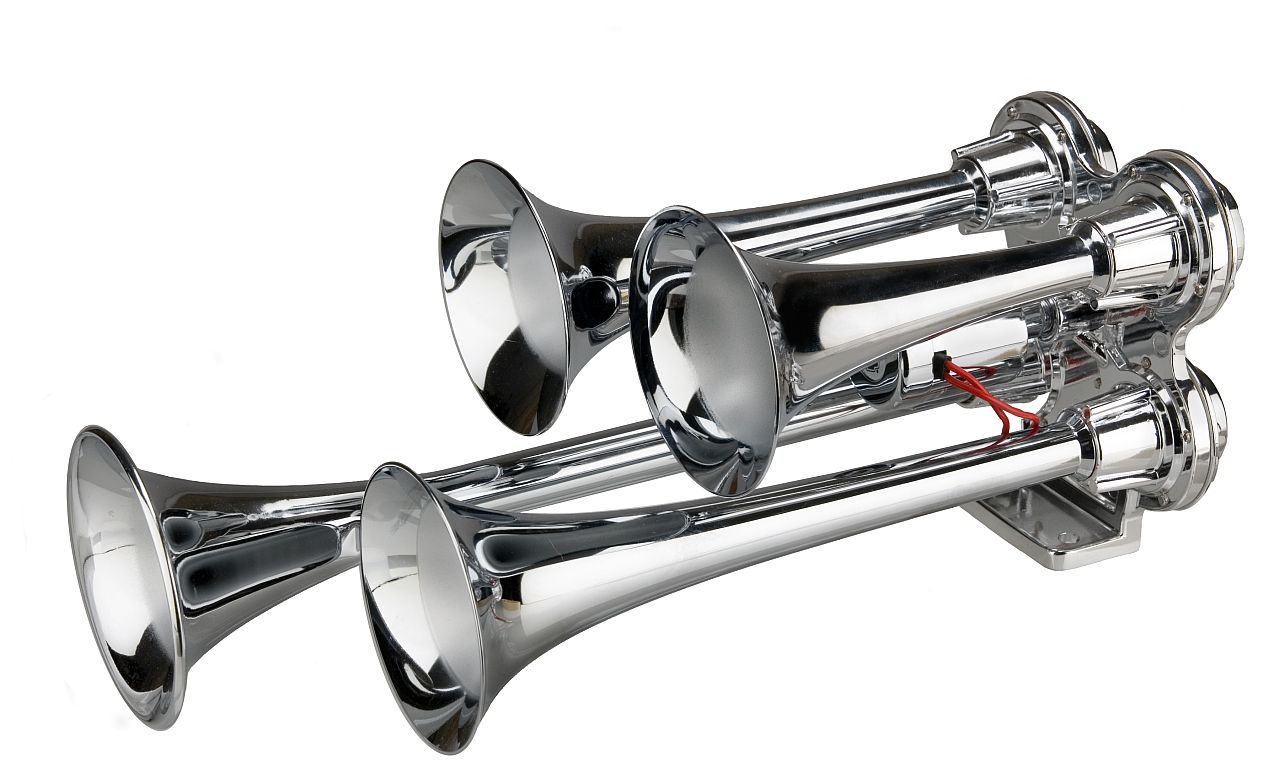
- +Compact 15″ × 5.5″ × 6″ — fits engine bays where larger 4-trumpet kits won't
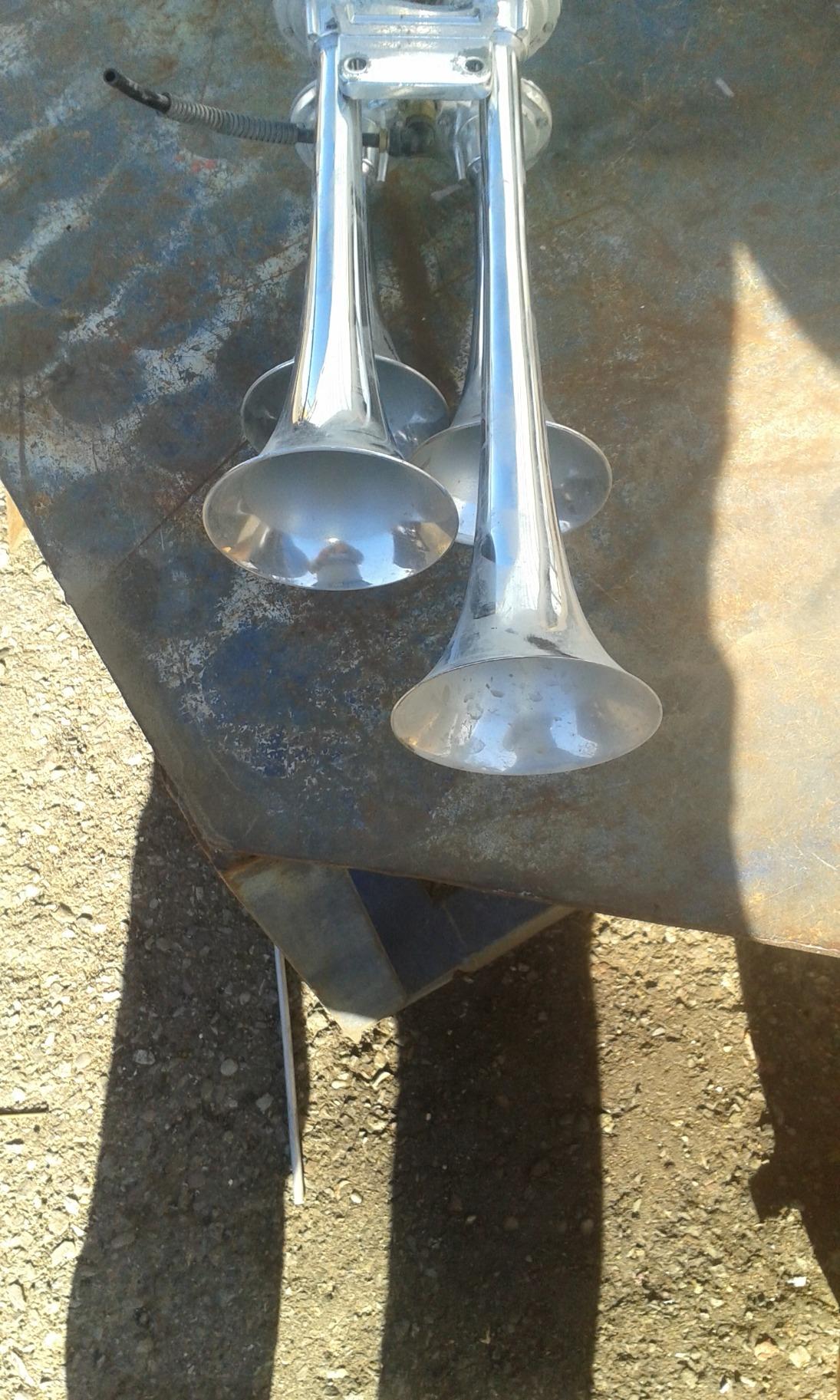
- +All-metal triple-chrome-plated construction
- +Disclosed Hz frequencies (290/421/548/648) — Wolo publishes real chord data
- +130 dB at 90/110 PSI — honest spec with disclosed test pressure
- +Long-running U.S. brand (Wolo Mfg., established 1965+) with mature service
- −130 dB output is the lowest in the major brand-name 4-trumpet category
- −Standalone only — needs aftermarket air system (Wolo recommends Model 800)
- −No published warranty length on Wolo's product page
- −Less aftermarket community support than HornBlasters or Kleinn
- −1/4″ air line spec is undersized vs the 1/2″ standard on competing kits
Methodology
This review aggregates publicly available information from Wolo Manufacturing’s product page, retailer listings (XDP, RealTruck, Amazon, Walmart), and standard SPL methodology references. We do not perform hands-on testing. All numeric claims cite their source. Last reviewed: September 10, 2026.
Quick verdict
The Wolo 853 Philly Express is, in editorial opinion, the best small-format 4-trumpet train horn. Wolo Manufacturing has been making air horns since the 1960s — they know acoustic engineering — and the 853 is one of the few aftermarket horns that publishes an honest dB spec at a disclosed test pressure (130 dB at 90/110 PSI). The 4 chord frequencies (290/421/548/648 Hz) are also disclosed, which is rare in the aftermarket. The trade-off: it’s the lowest-output 4-trumpet horn in the major brand-name category. We rate it 3.8/5 for buyers who specifically need a compact 4-trumpet at honest specs.
What it is
The Wolo 853 Philly Express is a 4-trumpet all-metal chord horn sold by Wolo Manufacturing (Wolo product page). The horn is sold standalone (Model 853) or in a complete kit with Wolo’s Model 800 on-board air system (Model 853-800, “Philly Express Pro”). The defining feature is its compact form factor — designed to fit engine bays that can’t accommodate a full-size train horn, while still delivering 4-chime chord output.
Specifications
All figures from the Wolo 853 product page:
| Spec | Value |
|---|---|
| Sound output | 130 dB at 90/110 PSI |
| Trumpet count | 4 |
| Trumpet material | All metal, triple chrome plated |
| Chord frequencies | 290 / 421 / 548 / 648 Hz |
| Horn dimensions | 15″ L × 5.5″ W × 6″ H |
| Air line | 1/4″ O.D. |
| Solenoid valve | 12–24 V, 300 mA |
| Operating PSI | 90 / 110 PSI cycle |
| Standalone horn price | $120–$200 (Wolo MSRP $119.99; varies by retailer) |
| Complete 853-800 kit price | $240–$430 (Wolo MSRP $429.99; ~$243 at discounters) |
| Warranty | Standard Wolo warranty (verify with reseller) |
As of our September 2026 re-check, both the standalone 853 and the 853-800 Pro kit are still listed out of stock on Wolo’s own store (Wolo rebuilt its website over the summer, but both product pages and MSRPs — $119.99 and $429.99 — are unchanged). Retailer stock has thinned since spring: NAPA lists the Pro kit at $276.17 but out of stock, RealTruck shows it temporarily unavailable, and Amazon’s 853 listing carries only third-party offers. Zoro still lists the Pro kit at $242.99, so the ~$243 discounter floor holds — but check stock before you plan an install around this horn.
What’s in the box
The standalone Model 853 includes:
- 1× 4-trumpet horn manifold (chrome-plated)
- Mount bracket
- Solenoid valve
- 1/4″ air line fittings
The Model 853-800 (Philly Express Pro) kit adds:
- Wolo Model 800 on-board air system: 2.5-gallon steel tank, 12 V oil-less compressor (21 A peak, 33% duty cycle), pressure switch cycling 80/110 PSI
- 10 ft of 1/4″ nylon high-pressure hose, 20 ft coiled filler hose, brass fittings
- Complete installation hardware
Why the Wolo dB spec is more credible than competitors
Most aftermarket horns claim “150 dB” or higher with no disclosed methodology. Wolo discloses 130 dB at 90/110 PSI — both the test PSI and the realistic operating range. This is the kind of spec that’s easy to verify and consistent with what a 4-trumpet metal horn at sub-150 PSI realistically produces.
Compare:
- Wolo 853 at 130 dB (disclosed at 90/110 PSI) — credible
- Kleinn 230 at 153.3 dB (no test distance disclosed) — likely close-throat measurement
- Vevor 4-Trumpet at 150 dB (no methodology) — likely 130–135 dB realistic at 3 ft
- HornBlasters Conductor’s 228H at 147.7 dB (3-ft test, methodology disclosed) — verified
Wolo’s 130 dB at 90/110 PSI is honest. It’s lower than the competition’s claimed numbers, but more accurate to what you’ll measure in your driveway with an SPL meter.
Pros and cons
Pros:
- Honest dB spec at disclosed test PSI — rare in the aftermarket.
- All-metal triple-chrome-plated construction — durable and looks good visible.
- Compact dimensions fit engine bays smaller kits won’t.
- Disclosed Hz frequencies — you know exactly what notes the chord plays.
- Mature manufacturer with decades of horn experience and established service network.
Cons:
- 130 dB is the lowest among major-brand 4-trumpet kits. Better dB-per-dollar from HornBlasters Conductor’s 228H or Kleinn 230 in the same form factor.
- 1/4″ air line spec is undersized vs the 1/2″ standard on most competing 4-trumpet kits — limits maximum airflow during sustained blasts.
- Standalone only — needs aftermarket air system unless you buy the 853-800 kit.
- Less aftermarket support than HornBlasters or Kleinn — fewer install guides, smaller community.
- No published warranty length on Wolo’s site — verify with reseller.
Compared to competing 4-trumpet kits
| Spec | Wolo 853 | HornBlasters Conductor’s 228H | Kleinn 230 (3-trumpet) |
|---|---|---|---|
| Trumpet count | 4 | 4 (Shocker XL) | 3 |
| Realistic dB at 3 ft | 130 | 147.7 | 143–148 |
| Trumpet material | All-metal chrome | Fiberglass-reinforced ABS | High-impact ABS |
| Operating PSI | 90/110 | 110/150 | 150 typical |
| Standalone price | $120–$200 | (sold as kit) | $214.95 |
| Complete kit price | $240–$430 (853-800) | $649.99–$749.99 | (with HK3-1 kit) |
| Aftermarket support | Limited | Extensive | Mature |
| Best for | Compact-bay value | Honest-spec mid-tier | Triple-trumpet value |
Alternatives
- HornBlasters Conductor’s Special 228H — 4 Shocker XL trumpets at 147.7 dB on a 2-gallon tank for $650+. Significantly louder, complete kit included.
- Kleinn 230 “The Beast” — 3-trumpet at $214.95 standalone. More dB output for similar price.
- Wolo 854 Dragon Express — Wolo’s larger sibling to the 853. (Forthcoming review.)

Frequently asked questions
Why is the Wolo 853 quieter than competitors?
Wolo discloses real test conditions; competitors don’t. 130 dB at 90/110 PSI is honest. The Vevor “150 dB” claim and Kleinn 230 “153.3 dB” claim are likely close-throat measurements that read 5–10 dB higher than the standard 3-ft test distance.
Will the Philly Express fit my truck?
Yes if you have at least 16″ × 7″ × 8″ of clearance. The 15″ × 5.5″ × 6″ horn dimensions fit most engine bays where larger HornBlasters / Kleinn 4-trumpet kits won’t. Verify clearance from heat sources (catalytic converter, exhaust manifold).
Is 130 dB enough?
For most aftermarket use cases, yes. 130 dB at 3 ft drops to ~110 dB at 30 ft and ~85 dB at 1 mile. Comparable to a portable battery train horn at the source. Below the 142 dB Outlaw 127H or 147.7 dB Conductor’s 228H, but well above OEM passenger vehicle horns.
Do I need the Wolo Model 800 air system?
Wolo recommends pairing with their Model 800 for the complete Pro kit. You can mix-and-match with HornBlasters or Kleinn air systems if you have one already, or with a Vevor budget tank/compressor. Verify the air system’s tank pressure cycle (cut-in / cut-out) matches the 90/110 PSI Philly Express operating range.
Is the 1/4” air line a problem?
For occasional use, no. For sustained blasts, the smaller line restricts airflow vs the 1/2” standard. If you upgrade the air line to 3/8” or 1/2” between tank and horn, you’ll get slightly better blast sustain.
Is the Wolo 853 legal on a road vehicle?
130 dB is right at typical state vehicle code caps (~110 dB). It’s marginally less risky from an enforcement standpoint than a 144+ dB kit, but still likely cited as “unreasonably loud” under most state vehicle codes. See /legal/ and /tools/state-legality/.
Sources
- Wolo Mfg. — Model 853 Philly Express Product Page (130 dB at 90/110 PSI, 290/421/548/648 Hz, all-metal chrome construction)
- Wolo Mfg. — Model 853-800 Philly Express Pro Page (Pro kit with Model 800 air system)
- NAPA — Wolo 853-800 Philly Express Pro (retailer price/stock reference, Sept 2026)
- Amazon — Wolo 853 Philly Express (cross-verification)
- XDP — Wolo 853-800 Philly Express Pro Kit (complete kit retailer reference)
- HornBlasters — Why Fake Decibel Ratings Mislead Buyers (industry context for honest spec disclosure)
Train Horn aggregates publicly available data. We do not test products in-house. All trademarks belong to their respective owners. Pricing and availability verified September 10, 2026.
The Wolo 853 is the right pick for buyers who specifically need a small 4-trumpet horn that fits a compact engine bay. Honest 130 dB spec at disclosed PSI. Less loud than HornBlasters / Kleinn alternatives but with a real published chord.
Frequently asked questions
Quick answers to the questions people ask most about this topic.
- How loud is the Wolo 853 Philly Express?
- Wolo discloses 130 dB at 90/110 PSI, with both the test PSI and operating range stated. That is the lowest output among major brand-name 4-trumpet kits, but it is an honest, verifiable spec rather than an inflated marketing number.
- Will the Philly Express fit my truck?
- Its compact 15 by 5.5 by 6 inch dimensions fit most engine bays where larger HornBlasters or Kleinn 4-trumpet kits will not, provided you have at least about 16 by 7 by 8 inches of clearance. Verify clearance from heat sources such as the catalytic converter and exhaust manifold.
- Do I need a separate air system for the Wolo 853?
- Yes. The standalone Model 853 is horn-only and needs an aftermarket air system. Wolo recommends pairing it with their Model 800 (sold together as the 853-800 Pro kit), and HornBlasters, Kleinn, or Vevor air systems also work if the tank's cut-in/cut-out cycle matches the 90/110 PSI operating range.
- What chord frequencies does the Wolo 853 play?
- Wolo publishes the four chord frequencies as 290, 421, 548, and 648 Hz, which is rare disclosure in the aftermarket. That means you know exactly what notes the chord plays rather than guessing.
- Is the quarter-inch air line on the Wolo 853 a problem?
- For occasional use, no. For sustained blasts, the quarter-inch line restricts airflow compared with the half-inch standard on competing kits. Upgrading the line to three-eighths or half-inch between tank and horn gives slightly better blast sustain.
- Is the Wolo 853 legal on a road vehicle?
- At 130 dB it sits near typical state vehicle code caps, making it marginally less risky from an enforcement standpoint than a 144-plus dB kit, but it can still be cited as unreasonably loud under most state vehicle codes.