- +All-metal, zinc-alloy powder-coated trumpets resist corrosion better than ABS rivals
- +Deep, genuinely loud three-trumpet train chord per user reviews
- +Cheap way to add a real train horn if you already run onboard air
- +Pre-installed 12V solenoid simplifies wiring and air connection
- +Wide availability with matching Vixen tank/compressor kits and parts
- −Advertised 'up to 152 dB' with no published test distance
- −Horn-only: you must supply a compressor and air tank
- −No chord-frequency (Hz) data published for paper comparisons
- −Warranty terms not clearly stated on the listing
- −Heavy all-metal cluster needs a rigid mounting point
Methodology
This review aggregates publicly available information from manufacturer specifications, retailer listings, and verified user reviews. We do not perform hands-on testing. Last reviewed July 25, 2026. For the Vixen Horns VXH3318B we originally relied on Vixen’s own product listing for the physical specs (dimensions, weight, materials, valve, hose, included hardware), the brand’s matching compressor kits for air-system context, and the Amazon listing plus Vixen’s marketing copy for the advertised sound level. At our July 2026 re-check, Vixen’s own store pages for this model no longer resolved, so current price and availability were re-verified against the Amazon listing. Where a number is advertised but its test conditions are not published, we say so plainly rather than repeat it as fact.
Quick verdict
The Vixen Horns VXH3318B is a horn-only triple-trumpet train horn aimed at buyers who already own — or plan to build — an onboard air system. It is honest about what it is (a loud, all-metal three-trumpet cluster with a 12V solenoid) and refreshingly cheap to add to an existing setup, but it is far less honest about how loud it actually is: Vixen’s marketing has advertised a sound level “up to 152 dB” with no test distance disclosed, and the current Amazon listing has dropped the number entirely — it now promises only “Super Loud dB”, with no decibel, PSI, or frequency figures anywhere. We rate it 3.7/5 — a solid value pick for DIY builders who care more about hardware quality than marketing numbers.
What it is
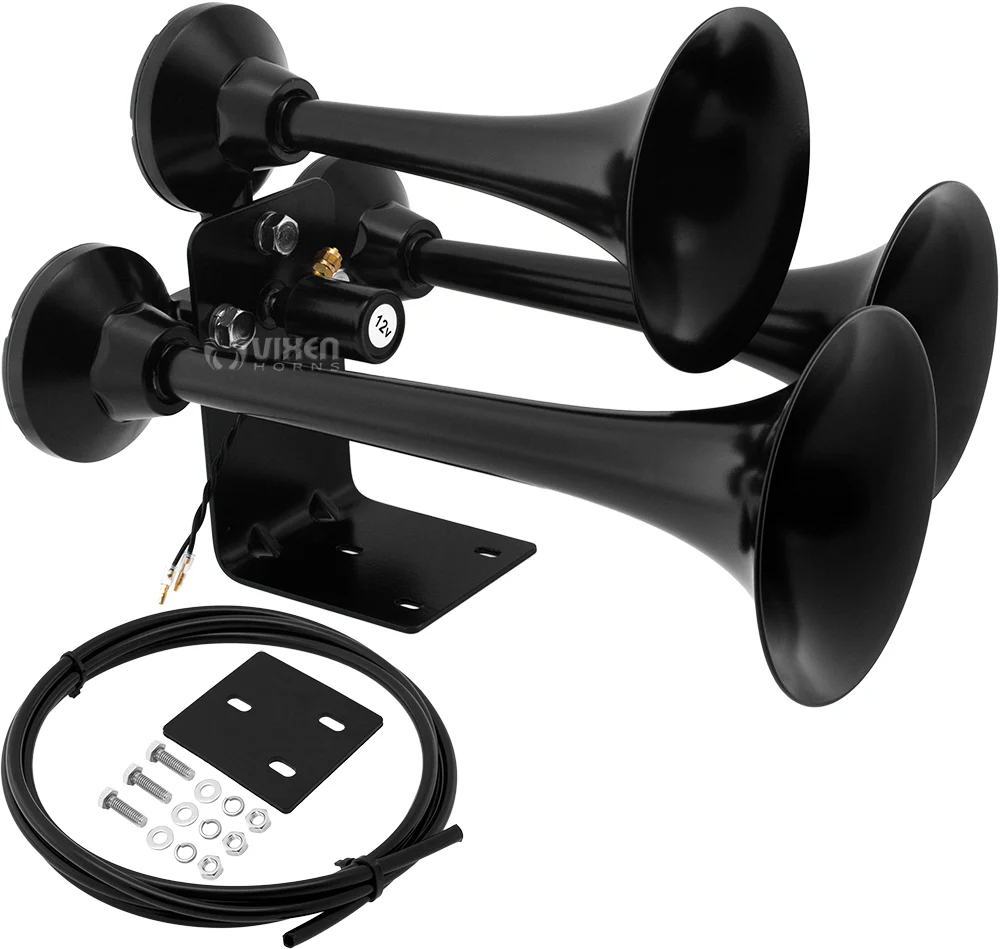
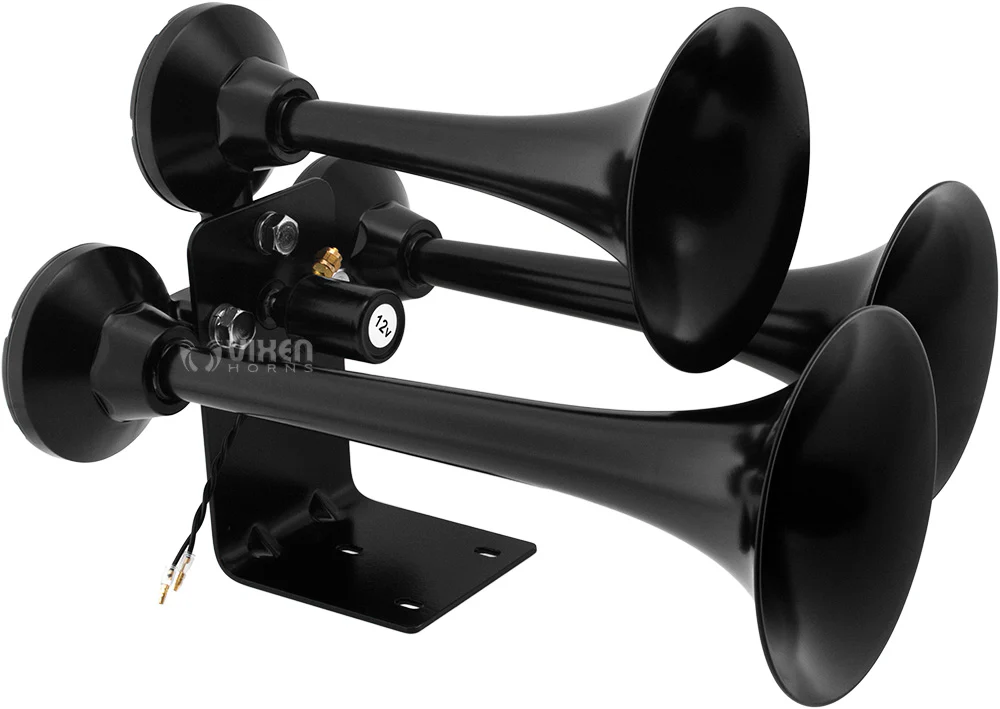
The VXH3318B is a standalone triple-trumpet train horn — three tuned zinc-alloy trumpets bolted to a common base, powder-coated black, with a single 12V electric solenoid air valve feeding all three. It is horn-only: there is no compressor and no air tank in the box. To make noise, it needs a separate onboard air source (a compressor-and-tank system, or a portable air tank) plumbed into the included hose.
That format makes it a poor fit for someone who wants a one-box plug-and-play kit, and a good fit for someone who already runs air — air suspension, an existing train-horn tank, or a Vixen compressor kit bought separately. Vixen has sold the same 3318B horn bundled with 1.5- to 3-gallon tanks and 150–200 PSI compressors under the VXO-series part numbers; kit availability shifts over time, so check current retailer listings for the exact bundle.
Specifications
| Spec | Value |
|---|---|
| Horn type | Triple-trumpet train horn (horn-only) |
| Trumpets | 3, tuned to different frequencies |
| Advertised sound level | Up to 152 dB in past marketing (test distance not disclosed; current listing states no number) |
| Operating PSI | Not disclosed for the horn; pairs with 150–200 PSI compressor kits |
| Chord frequencies (Hz) | Not disclosed |
| Material | All-metal body; zinc-alloy trumpets, black powder-coat |
| Air valve | 12V electric solenoid |
| Hose | ¼” OD nylon, 6 ft |
| Dimensions | 16¼” L × 15” W × 11” H |
| Power source | Requires onboard air system (air tank) |
| Mounting hardware | Included |
| Price | ~$155 at Amazon as of July 2026 (retailer pricing varies) |
- Best for
- DIY builders who already run onboard air
- Not for
- Anyone wanting a complete plug-and-play kit in one box
- Power
- External air tank + compressor (sold separately)
What’s in the box
- Triple-trumpet train air horn (black), assembled
- 12V electric air valve (solenoid), pre-installed
- ¼” OD nylon plastic hose, 6 feet
- Mounting hardware
Note what is not included: no compressor, no air tank, no pressure switch, no wiring relay, and no air line beyond the single 6-foot hose. Budget for those separately if you do not already have an air source.
Pros
- All-metal construction with zinc-alloy, powder-coated trumpets — better corrosion resistance than the ABS-plastic horns in this price range.
- Genuinely loud three-trumpet chord; user reviews consistently describe a deep, train-like tone rather than a thin single-note blast.
- Cheap way to add a real train horn if you already own an air system — no need to re-buy a compressor and tank.
- Pre-installed 12V solenoid means simpler wiring; the valve and hose connection are handled out of the box.
- Wide availability and a clear upgrade path — Vixen sells matching tank-and-compressor kits and replacement parts under the VXO part numbers.
- Compact-for-a-triple footprint (16¼”) fits many truck, SUV, and Jeep mounting locations.
Cons
- Acoustic honesty is weak: “up to 152 dB” has been advertised with no published test distance, and the current listing publishes no dB, PSI, or frequency data at all.
- Horn-only — you must supply a compressor and tank, which can cost as much as or more than the horn itself.
- No chord-frequency (Hz) figures published, so you cannot compare its tuning against premium horns like Nathan or Leslie on paper.
- Warranty terms are not clearly published on the product listing; coverage details are vague compared with brands like HornBlasters.
- Being all-metal, it needs a solid mounting point — flimsy brackets will rattle or sag over time per user reports.
Alternatives
- Vevor 4-Trumpet — an even cheaper four-trumpet horn-only option; louder-looking on paper but with similar marketing-number caveats and lighter construction.
- Wolo Dragon Express 854 — a self-contained 12V air horn with its own small compressor, better for buyers who do not want to build an air system.
- Kleinn 230 — a triple horn from a brand with stronger documentation and dealer support, typically at a higher price.
If you want the loudest options ranked, see our loudest train horn guide, and the Vixen Horns hub for the rest of the lineup.
Install / compatibility notes
The VXH3318B fits any 12V vehicle, but it is only half of a working setup. To install it you need:
- An air source — a compressor and air tank (typically a 1.5–5 gallon tank charged to 150–200 PSI), or a portable/onboard air tank you already run. The horn’s loudness scales with the pressure and air volume you feed it, which is exactly why undisclosed-PSI marketing numbers are hard to trust.
- Air plumbing — connect the included 6-foot ¼” hose from the tank/manifold to the horn’s solenoid inlet. Longer runs need additional line.
- Electrical wiring — the 12V solenoid draws enough current that a relay and an inline fuse are recommended; wire the trigger to a horn button or a switched 12V source.
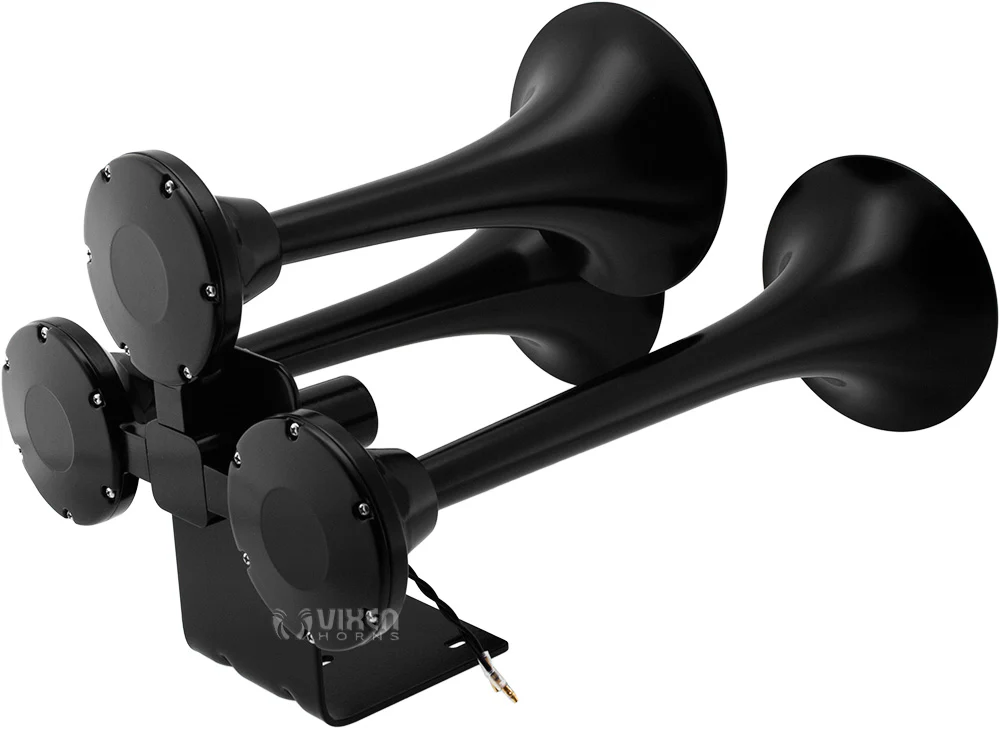
- A rigid mount — being a heavy all-metal cluster, mount it to frame rail, bed, or a reinforced bracket, trumpets angled down and rearward to keep water out.
For a full walkthrough, see our train horn install guide and the PSI explainer to size your tank and compressor correctly. If you would rather buy everything together, look for Vixen’s VXO-series kits that pair this horn with a tank and compressor (availability varies by retailer).
FAQ
How loud is the Vixen VXH3318B really?
Vixen has advertised “up to 152 dB,” but never published the test distance, and the current Amazon listing states no decibel figure at all — just “Super Loud dB.” In practice, a triple-trumpet horn fed by a properly pressurized tank is extremely loud — well into hearing-damage territory up close — but the 152 dB number should be treated as marketing, not a measured spec. Real-world loudness depends heavily on your air pressure and tank volume.
Does it come with an air compressor or tank?
No. The VXH3318B is horn-only. It includes the three trumpets, a 12V solenoid valve, a 6-foot ¼” hose, and mounting hardware. You must supply your own compressor and air tank, or buy one of Vixen’s VXO-series kits that bundle this horn with an air system.
What PSI does it need?
Vixen does not publish a specific operating PSI for the bare horn. Its matching kits use 150–200 PSI compressors, and most train horns sound best somewhere in the 100–150 PSI working range. More pressure and more stored air volume generally mean a louder, longer blast.
Is it metal or plastic?
The VXH3318B is all-metal, with zinc-alloy trumpets finished in black powder coat for corrosion resistance. That is a step up from the ABS-plastic horns Vixen also sells (the “XB” ABS variants), and a reason this model holds up better outdoors per user reports.
Will it fit my truck or Jeep?
It fits any 12V vehicle electrically. Physically it measures about 16¼” long, so you need a flat, rigid mounting area — under the bed, along a frame rail, or behind the grille on larger trucks and SUVs. Compact cars may struggle to fit a triple-trumpet cluster this size.
Is the Vixen VXH3318B worth it?
For a buyer who already runs onboard air and wants a loud, durable, metal triple-trumpet horn on a budget, yes. For someone who wants a complete, one-box plug-and-play kit with transparent acoustic specs, a documented warranty, and dealer support, a full kit from HornBlasters or Kleinn is a better fit even at a higher price.
Sources
- Amazon — Vixen Horns VXH3318B listing (ASIN B01CGUKYMU) — retailer listing used for current price and stock (re-verified July 2026), the “Super Loud dB” marketing copy, and 12V compatibility
- Vixen Horns — VXH3318B triple trumpet train air horn (black) product page on vixenhorns.com — original source for physical specs (dimensions, weight, all-metal/zinc-alloy construction, 12V solenoid, 6 ft ¼” hose, included hardware) and product photos; the page no longer resolved at our July 2026 re-check, so the link has been removed
- Vixen Horns — VXO8560/3318B kit with 2-gallon tank and 150 PSI compressor — context for the matching air-system kits and compressor PSI range; page no longer live on vixenhorns.com as of July 2026
A solid, durable triple-trumpet train horn for DIY builders who already own an onboard air system and value all-metal hardware over marketing decibel numbers; skip it if you want a transparent-spec, one-box plug-and-play kit.
Frequently asked questions
Quick answers to the questions people ask most about this topic.
- How loud is the Vixen VXH3318B really?
- Vixen has advertised up to 152 dB, but never published the test distance, and the current Amazon listing states no decibel number at all, just 'Super Loud dB'. A triple-trumpet horn fed by a properly pressurized tank is extremely loud up close, but the 152 dB figure should be treated as marketing, since real-world loudness depends on your air pressure and tank volume.
- Does the VXH3318B come with an air compressor or tank?
- No, it is horn-only. It includes the three trumpets, a pre-installed 12V solenoid valve, a 6-foot quarter-inch nylon hose, and mounting hardware. You must supply your own compressor and air tank, or buy one of Vixen's VXO-series kits that bundle this horn with an air system.
- What PSI does the VXH3318B need?
- Vixen does not publish a specific operating PSI for the bare horn. Its matching kits use 150 to 200 PSI compressors, and more pressure plus more stored air volume generally mean a louder, longer blast.
- Is the VXH3318B metal or plastic?
- It is all-metal, with zinc-alloy trumpets finished in black powder coat for corrosion resistance. That is a step up from the ABS-plastic horns Vixen also sells and a reason this model holds up better outdoors per user reports.
- Will the VXH3318B fit my truck or Jeep?
- It fits any 12V vehicle electrically. Physically it measures about 16 and a quarter inches long, so you need a flat, rigid mounting area such as under the bed, along a frame rail, or behind the grille. Compact cars may struggle to fit a triple-trumpet cluster this size.