- +Genuine Nathan K-series kettle-drum bells, not a stamped-trumpet imitation
- +Bright B major chord from bells #1, #2, and #4A, the same voicing as the K3LA
- +$899.95 is the lowest current price we found for a rebuilt three-chime K horn
- +Rebuilt with new hardware and stainless internals; every bell tested
- +Wide 90–140 PSI operating window suits aftermarket onboard air
- +About 28 lb with a 1/2" NPT inlet, easier to mount than a five-chime
- −No decibel rating published by Nathan or LPS
- −No warranty stated on the LPS listing
- −Stock photos only, with cosmetic variance and no cosmetic returns
- −Bare horn: valve, tank, compressor, line, and bracket are extra
- −Refurb stock rotates; it was sold out as recently as September 2026
- −High-profile manifold adds height for low-clearance installs
Methodology
This review aggregates publicly available information from manufacturer specifications, retailer listings, and verified user reviews. We do not perform hands-on testing. Specs come from the Locomotive Parts Supply (LPS) listing for the refurbished K3HA, which is the only current retail source for this exact model we could confirm. We cross-checked it against Wikipedia’s Nathan Manufacturing entry for bell pitches and naming history, and the Federal Railroad Administration’s horn rule for regulatory context. Nathan AirChime sells to railroads and does not publish consumer spec sheets for individual horns, so the retailer listing is the primary spec source here. Last reviewed: October 4, 2026.
Availability note: LPS showed the K3HA as in stock at $899.95 when we checked on 10/04/2026. When we reviewed the sibling K3HL in September 2026, the K3HA was sold out at the same price. LPS sells refurbished horns pulled from retired locomotives, so stock comes and goes as cores arrive.
Quick verdict
The Nathan AirChime K3HA is the cheapest way we have found to buy a real Nathan K-series locomotive horn from a retailer that rebuilds its units. It plays bells #1, #2, and #4A, the same bell set as the commuter-rail K3LA, so you get a bright major chord instead of the dark “HL” growl. It does this on a high-profile manifold for $899.95. In our editorial opinion, that price makes it the value pick of the three-chime K horns. The deductions are the usual ones for refurbished locomotive horns: no published decibel rating, no warranty on the listing, stock photos with cosmetic variance disclosed, and a bare horn that still needs serious air behind it. We rate it 4.1/5.
What it is
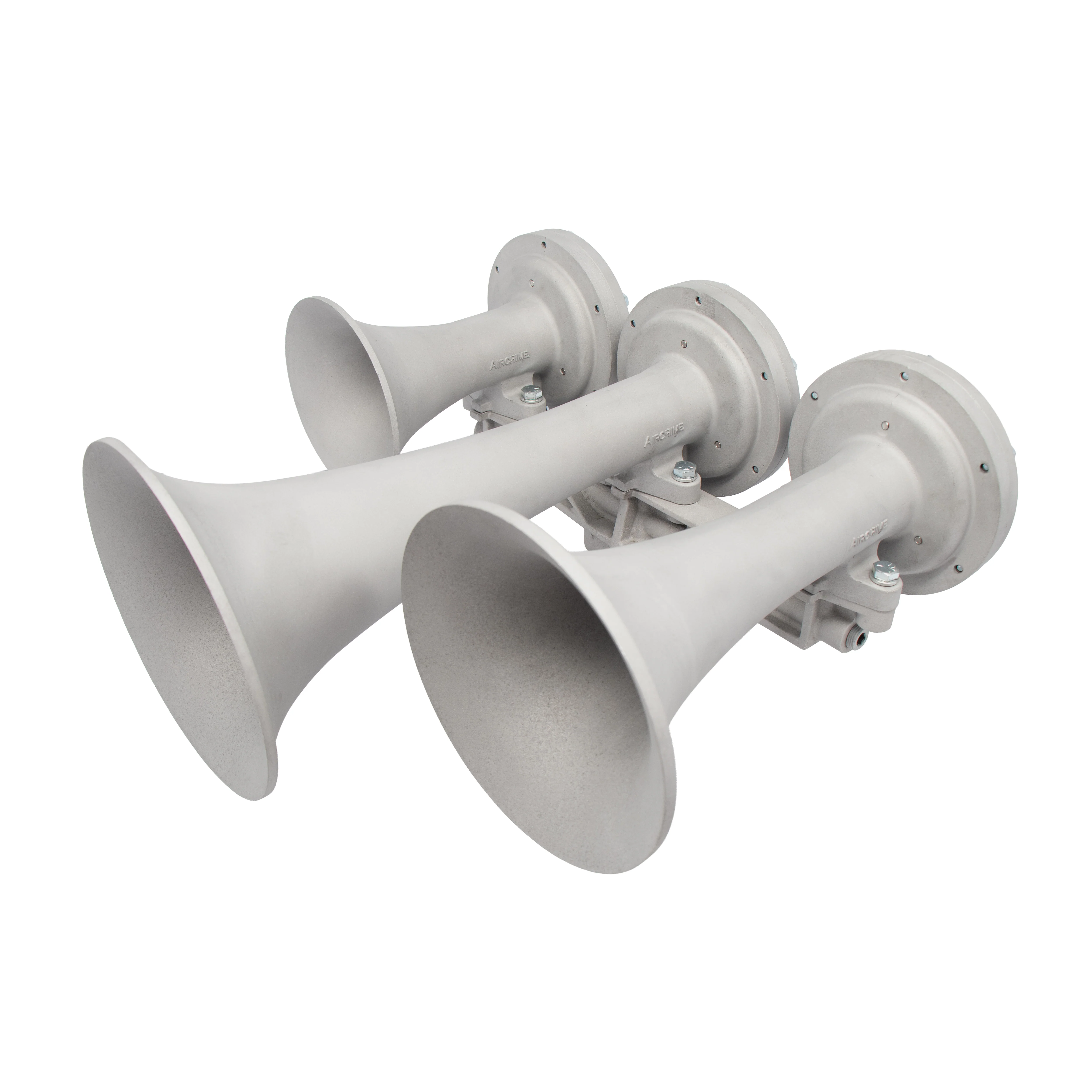
The K3HA is a three-chime cast locomotive air horn from Nathan AirChime’s K-series. Wikipedia’s Nathan Manufacturing entry dates the series to 1954, when the K5H and K3H debuted. “K” means the double-diaphragm kettle-drum bell design. “H” first meant “high-pitched” and later came to mean the high-profile manifold, and “L” marks the low-profile manifold. The same entry explains that the “A” in K5LA stands for American tuning, as opposed to the original Canadian D-sharp minor tuning. The K3HA follows the same logic: three bells, high manifold, American-tuned. Wikipedia’s K-series list also catalogs related variants such as the K-3HA-R2.
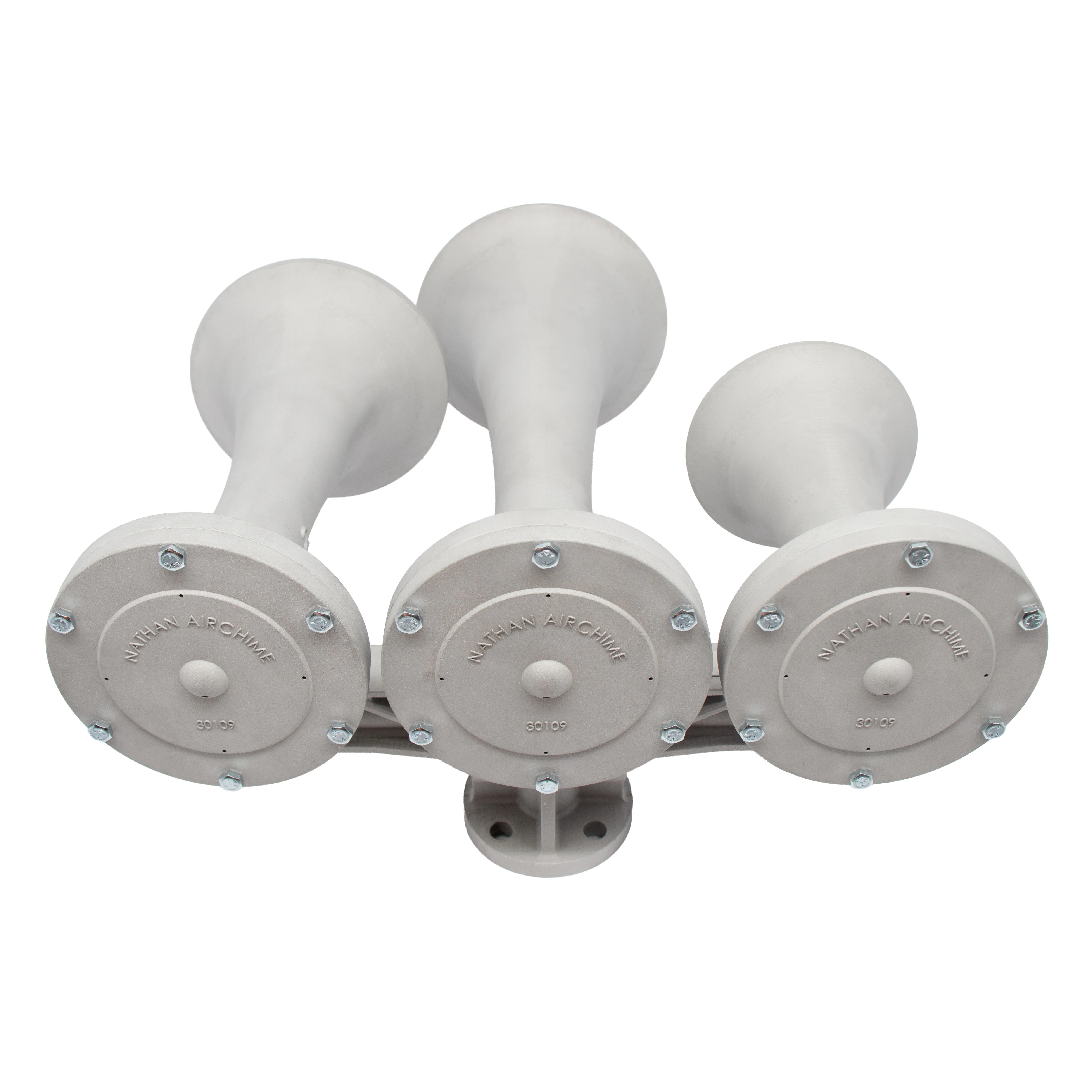
In practice the K3HA is the high-mount twin of the K3LA. Both use bells #1, #2, and #4A. The K3HA’s taller manifold puts the bells higher off the mounting surface, which matters for roof installs and for clearing obstructions on a deck or bracket.
The unit sold by LPS is refurbished. LPS describes it as tested and fully functional with all three bells working, bead-blasted and resurfaced, and rebuilt with new hardware and stainless steel internals. LPS markets it as the classic K-series tone “in a more compact and lightweight form” for custom installs, commercial vehicles, and enthusiasts who want real railroad sound without the bulk of a five-chime. This is a standalone horn: manifold and bells only. For the rest of the brand’s lineup, see our Nathan AirChime reviews hub.
Specifications
| Spec | Value |
|---|---|
| Type | 3-chime cast locomotive air horn, high-profile manifold |
| Bells | #1, #2, #4A (KS-1, KS-2, KS-4A) |
| Bell pitches | KS-1 ≈ 311 Hz (D♯4) · KS-2 ≈ 370 Hz (F♯4) · KS-4A ≈ 490 Hz (B4) |
| Chord (nominal) | D♯ · F♯ · B, a B major triad in first inversion |
| Operating pressure | 90–140 PSI |
| Air inlet | 1/2” NPT |
| Weight | Approx. 28 lb |
| Dimensions (approx.) | 16.5” L × 19.5” W × 10.75” H |
| Sound output | No manufacturer or retailer dB rating published |
| Regulatory context | FRA requires 96–110 dB(A) at 100 ft for in-service locomotive horns |
| Material / finish | Cast metal bells and manifold, bead-blasted finish |
| Internals | New hardware and stainless steel internals (per LPS) |
| Condition | Refurbished, tested; cosmetic dings or scratches possible |
| Price | $899.95 (LPS, in stock 10/04/2026) |
| Warranty | None stated on the LPS listing |
| Power source | Compressed air (tank and compressor required) |
The bell frequencies come from Wikipedia’s Nathan bell chart, not from LPS. LPS lists only the bell numbers. Put together, D♯4, F♯4, and B4 spell a B major triad, the cheerful “American” sound that Wikipedia credits to Amtrak’s 1975 push for a re-tuned K horn.
- Bells
- #1 / #2 / #4A
- Pressure
- 90–140 PSI
- Inlet
- 1/2” NPT
- Weight
- ~28 lb
- Price
- $899.95 (refurb)
What’s in the box
- One Nathan AirChime K3HA manifold with three bells (#1, #2, #4A), per the LPS “Includes” line
- New hardware and stainless steel internals installed during the rebuild
- Bead-blasted, resurfaced castings, with each bell tested before shipping
- 1/2” NPT inlet ready for a standard air fitting
That is the whole list. There is no solenoid valve, air line, tank, compressor, mounting bracket, or wiring. LPS also says the listing uses stock photos, that castings “may vary slightly in appearance due to age,” and that returns over minor cosmetic differences are not accepted as “item not as described.”
Pros
- Genuine Nathan K-series kettle-drum bells, not a stamped-trumpet imitation
- Bright B major chord from bells #1, #2, and #4A, the same voicing as the K3LA used on commuter equipment
- $899.95 is the lowest current price we found for a rebuilt three-chime K horn, about $250 below LPS’s last K3HL price
- Rebuilt with new hardware and stainless internals rather than sold as-is, with every bell tested
- Wide 90–140 PSI operating window that suits aftermarket onboard air systems
- About 28 lb with a 1/2” NPT inlet, much easier to mount and feed than a roughly 40 lb five-chime
Cons
- No decibel rating from Nathan or LPS, so any “160 dB” marketplace claim has no source behind it
- No warranty stated on the LPS listing
- Stock photos only, with possible dings and scratches and no returns over cosmetic differences
- Bare horn: the valve, tank, compressor, line, and bracket are all extra
- Stock depends on locomotive retirements; it was sold out as recently as September 2026
- The high-profile manifold adds height, which can be a problem on low-clearance or under-body installs
Alternatives
- Nathan AirChime K3LA: the same three bells and the same major chord on the low-profile manifold, which suits tight under-body or bumper-adjacent spaces better. See our K3LA review.
- Nathan AirChime K3HL: the same high manifold, but the low #1L bell replaces #4A for the dark Union Pacific growl. LPS last listed it at $1,149.95 when we reviewed it in September 2026. See our K3HL review.
- Nathan AirChime K5HA: the five-chime high-mount version with the full B major 6th chord. It is bigger, heavier, hungrier for air, and several times the price. See our K5HA review.
Deciding between three and five bells? Our K3LA vs. K5LA comparison walks through the size, weight, and air-supply math, and it applies directly to the K3HA, since it shares the K3LA’s bells. If you are shopping the used market instead, read our used locomotive horn buying guide first.
Install / compatibility notes
The K3HA is a locomotive part, and it expects locomotive-class air. LPS rates it for 90 to 140 PSI, and Wikipedia’s train-horn overview puts typical locomotive supply at 125 to 140 PSI. Plan your system around the top of that range if you want the full chord rather than a thin bark.
- Air supply. In our editorial view, a 5-gallon or larger tank with a 150 PSI-class compressor is the realistic minimum for repeated blasts. A 1-gallon truck-kit tank will give a short honk and a long refill. Our tank sizing guide covers the math.
- Valve and line. Feed the 1/2” NPT inlet with a 1/2” solenoid valve on a short, large-bore line. Stepping down to 1/4” line starves the diaphragms. See our air line sizing guide.
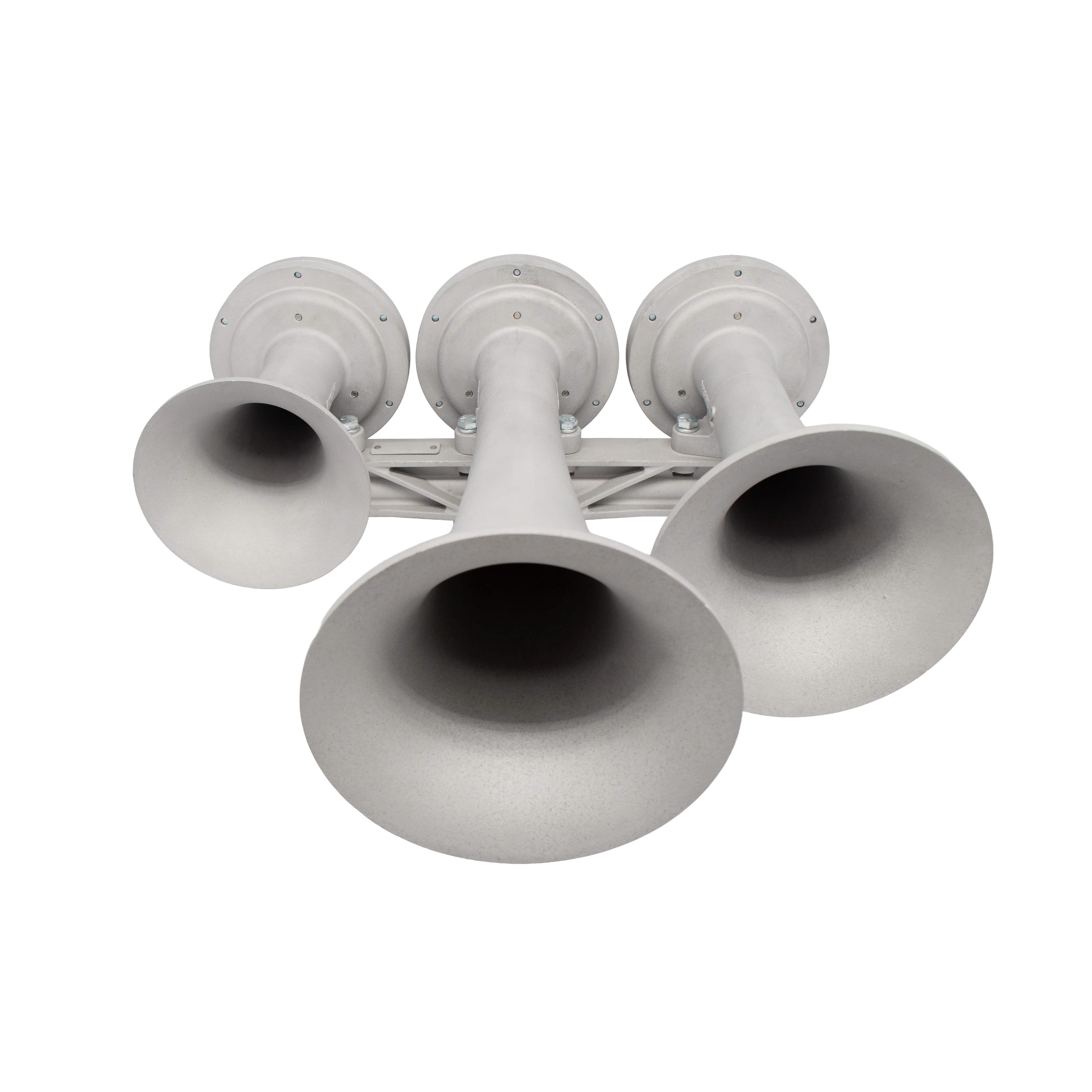
- Mounting. At roughly 28 lb on a 16.5” × 19.5” footprint, with 10.75” of height from the high manifold, the K3HA needs a frame-mounted or roof-rack bracket that bolts through the manifold foot, not a thin bumper tab.
- Electrical. The horn has no electrical parts. Only the valve and compressor do. Fuse and relay the compressor circuit correctly using our relay wiring guide.
- Legal use. HornBlasters’ own testing page calls the Nathan K5 platform’s 149.4 dB at 3 ft the ceiling for horn loudness. Treat the K3HA as off-road, marine, agricultural, or display equipment, and check train horn legality before wiring it to a horn button.
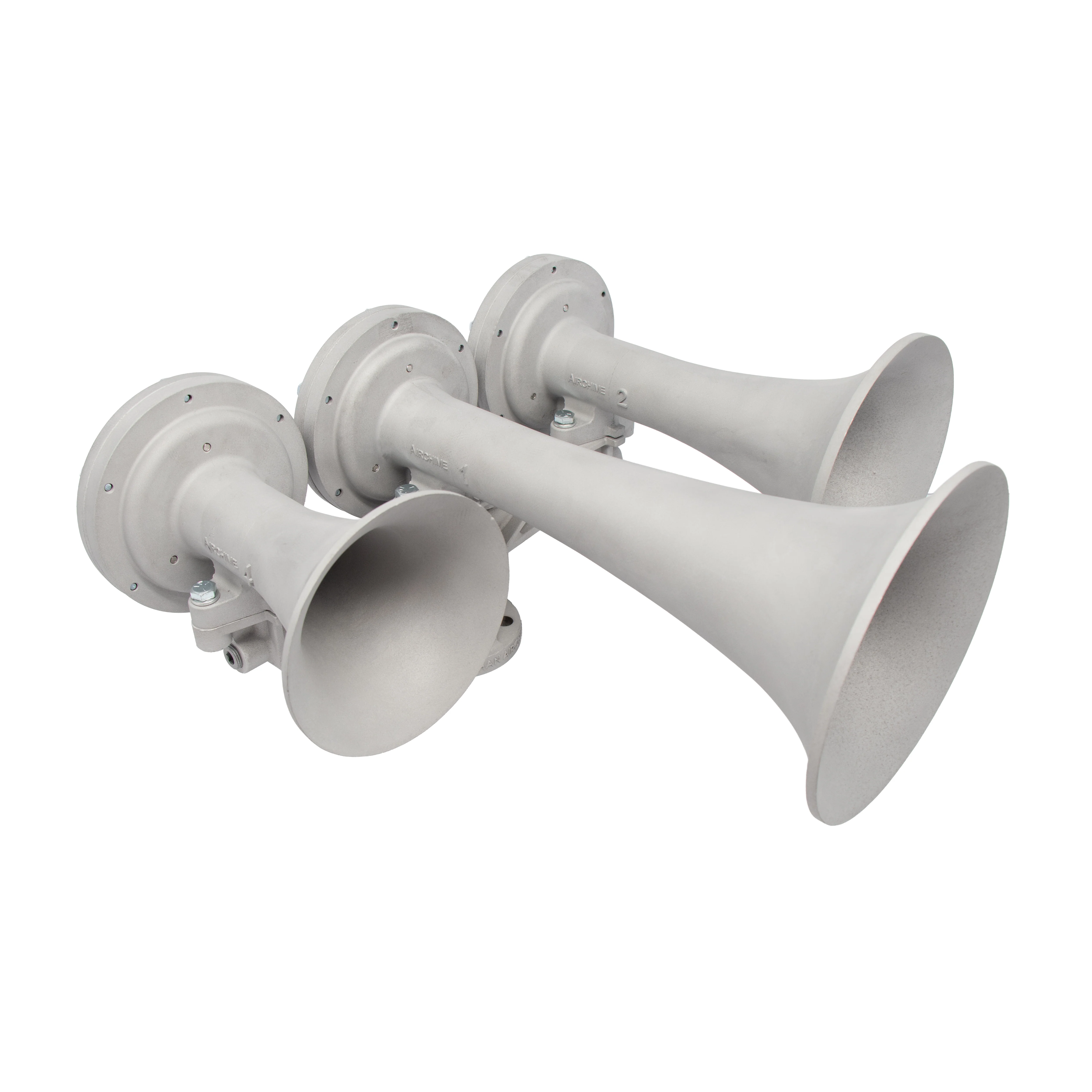
One practical tip: the bell lengths make the K3HA visibly asymmetric. The #1 bell is the longest and the #4A is the shortest, so check bell-mouth clearance on the side you plan to face forward. Because LPS ships whichever refurbished core is on the shelf, ask about the casting’s condition before you buy if appearance matters for a show build.
Sources
- Locomotive Parts Supply — Nathan Airchime K3HA Locomotive Train Horn — bells #1/#2/#4A, 90–140 PSI, 1/2” NPT, ~28 lb, 16.5” × 19.5” × 10.75”, $899.95 price and in-stock status (10/04/2026), refurbishment details (bead-blasted, new hardware, stainless internals, tested), stock-photo and cosmetic-return disclosure, no dB or warranty stated, product photos
- Locomotive Parts Supply — Nathan Airchime K3HL Locomotive Train Horn — K3HL alternative: bells #1L/#1/#2, $1,149.95, sold out (rechecked 10/04/2026)
- Locomotive Parts Supply — Nathan Airchime K5HL Locomotive Train Horn — five-chime weight of approx. 40 lb
- HornBlasters — Nathan Airchime K5HA Train Horn — K5HA alternative: $4,499.99, 37 lb
- Wikipedia — Nathan Manufacturing — 1954 K5H/K3H debut, K/H/L/A naming, “A” for American tuning, 1975 Amtrak re-tuning, K-3HA-R2 variant listing, Metra/commuter use of the K3LA, bell pitch chart (KS-1 D♯4 311 Hz, KS-2 F♯4 370 Hz, KS-4A B4 490 Hz)
- Wikipedia — Train horn — typical locomotive horn supply pressure of 125–140 PSI
- HornBlasters — Why Fake Decibel Ratings Mislead Buyers — Nathan K5 platform measured at 149.4 dB at 3 ft as the practical ceiling; context for unsourced dB claims
- Cornell LII — 49 CFR § 229.129 Locomotive horn — FRA minimum 96 dB(A) and maximum 110 dB(A) measured 100 ft ahead of the locomotive
Train Horn Hub aggregates publicly available data. We do not test products in-house. All trademarks belong to their respective owners.
The value pick of the three-chime Nathan K horns: the K3LA's bright major chord on a high-mount manifold for $899.95 refurbished. It's best for builders who already have, or plan to add, a 150 PSI-class air system and can live without a stated warranty.
Frequently asked questions
Quick answers to the questions people ask most about this topic.
- How loud is the Nathan K3HA?
- Neither Nathan nor Locomotive Parts Supply publishes a decibel figure for the K3HA. For context, HornBlasters measured the Nathan K5 platform at 149.4 dB at 3 ft, and the FRA requires in-service locomotive horns to measure 96–110 dB(A) at 100 ft. Any '160 dB' marketplace claim has no source behind it.
- What chord does the K3HA play?
- It uses bells #1, #2, and #4A, which Wikipedia's Nathan bell chart lists at roughly 311 Hz (D♯4), 370 Hz (F♯4), and 490 Hz (B4). Together they form a B major triad, the 'American' tuning that the A in the model name refers to.
- What's the difference between the K3HA and the K3LA?
- They use the same three bells (#1, #2, #4A) and play the same chord. The K3HA sits on the high-profile manifold, while the K3LA uses the low-profile manifold, so the choice mostly comes down to mounting height and clearance.
- What does the K3HA cost and what is included?
- Locomotive Parts Supply listed a refurbished K3HA at $899.95 and in stock on 10/04/2026. You get the manifold and three bells, rebuilt with new hardware and stainless internals. No valve, tank, compressor, bracket, or wiring is included, and the listing states no warranty.
- What air system does the K3HA need?
- LPS rates it for 90–140 PSI through a 1/2-inch NPT inlet. In our editorial view, plan on a 5-gallon or larger tank, a 150 PSI-class compressor, and a 1/2-inch solenoid valve on a short, large-bore line.