- +Authentic 1950s locomotive hardware from the most musical horn family ever made
- +Warm C#-E-A chord with bell frequencies documented in Nathan's 1951 catalog
- +Wide 20-100+ PSI operating range holds a true tone at low pressure
- +Refurbished and powder-coated to order with a one-year warranty
- +Simple serviceable design with only two wearing parts per bell
- −Bare horn only - no compressor, tank, valve, or hardware included
- −No official dB rating; vendor loudness claims are unverifiable
- −Out of production for decades, so parts are collector territory
- −Premium price plus up to 2-3 weeks lead time
- −Seller's website was unreachable at review time
Methodology
This review aggregates publicly available information from manufacturer specifications, retailer listings, and verified user reviews. We do not perform hands-on testing. Last reviewed: August 29, 2026. Our sources for this article include the original 1951 Nathan Airchime M-series catalog, Wikipedia’s Nathan Manufacturing entry, the Air Horns of Texas listing, Nathan’s current official site, HornBlasters’ renewed-horn pricing for context, the active eBay used market, and YouTube demonstrations. One sourcing note: the Air Horns of Texas website was unreachable at review time, so listing details below were verified against an October 2025 archived capture of the product page. Confirm current pricing and availability with the seller directly before ordering.
Quick verdict
The Nathan AirChime M3 is not a truck horn kit — it is a genuine piece of 1950s locomotive hardware, the three-chime version of the M-series that collectors widely consider the most musical family of train horns ever built. Refurbished examples sell in the $1,500+ range with a powder-coat finish of your choice, and you get exactly one thing for that money: the horn itself, with its warm C♯–E–A chord. There is no compressor, no valve, no published decibel rating, and no current factory support, so this is a horn for collectors and dedicated builders rather than first-time buyers. We rate it 4.0/5 — magnificent sound and history, demanding ownership.
What it is
The M-series was AirChime’s first mass-adopted chime horn line, developed by Robert Swanson, with tuning input from Captain Charles Benter, the first leader of the United States Navy Band. Wikipedia’s Nathan Manufacturing entry credits the collaboration with producing “the most melodic horn in railroading.” The M3 is the three-chime member of the family: per the original 1951 Nathan catalog, it mounts bells 1, 2, and 4 on a dedicated three-bell base and was aimed at “general freight or switcher service,” with the five-chime M5 reserved for passenger power. The catalog is candid that the M3 is “somewhat less euphonious in sound than the M5, but more than adequate for its purposes.” North of the border, the Canadian-built M3H variant (which Wikipedia notes used bells 2, 3, and 4) became the standard three-chime horn on Canadian railroads, which is why M-series sound is so strongly associated with CN and other Canadian roads.
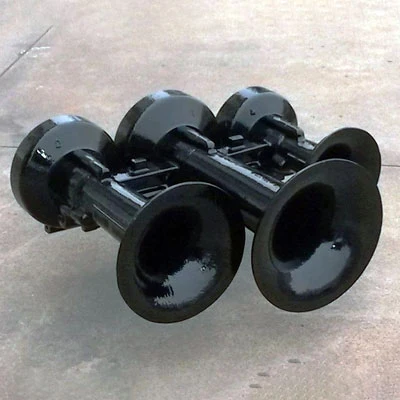
Production of the M-series gave way to the P-series and later the K-series, which were simpler to maintain; Nathan’s current official catalog lists only K, C, P, and KSJ series horns, so every M3 on the market today is decades-old hardware. Air Horns of Texas, a Texas air-horn retailer with over 27 years in the business, sells refurbished M3 horns powder-coated in your choice of colors, and a steady trickle of original M3 and M3H horns moves through eBay’s Nathan Airchime category.
Specifications
| Spec | Value |
|---|---|
| Type | 3-chime cast locomotive air horn (discontinued M-series) |
| Bells | Bells 1, 2, and 4 on a three-bell manifold base |
| Chord | C♯–E–A (A major, first inversion) |
| Bell frequencies | 277.18 Hz, 329.6 Hz, 440.0 Hz |
| Operating pressure | 20 to over 100 PSI |
| Weight | 28 lb (per the 1951 Nathan catalog) |
| Construction | Cast aluminum bells and base; phosphor-bronze diaphragms |
| Air connection | Bottom or alternate inlet ports; 1/2” minimum supply line recommended |
| Sound output | No official dB rating published (see note below) |
| Condition as sold | Refurbished, powder-coated (Black, Silver, or custom color) |
| Price | $1,550 (Black/Silver) / $1,650 (custom color), as last listed |
| Warranty | 1 year (Air Horns of Texas), with 100% satisfaction guarantee |
| Lead time | Up to 2–3 weeks to ship, depending on demand |
A note on loudness: Nathan never published a decibel figure for the M-series, and the horn predates modern locomotive-horn measurement standards. If you see “160–170 dB” attached to an M3 listing anywhere, treat it as marketing, not measurement — no cast locomotive horn has a verified figure like that. What can be said honestly: this is a true locomotive-class horn that, per the 1951 catalog, “produces a tone which penetrates for miles” at full line pressure, and YouTube demos of M3 and M3H horns make consumer truck-horn kits sound thin by comparison. For context on why advertised numbers mislead, see our guide to advertised vs real-world decibels.
What it includes
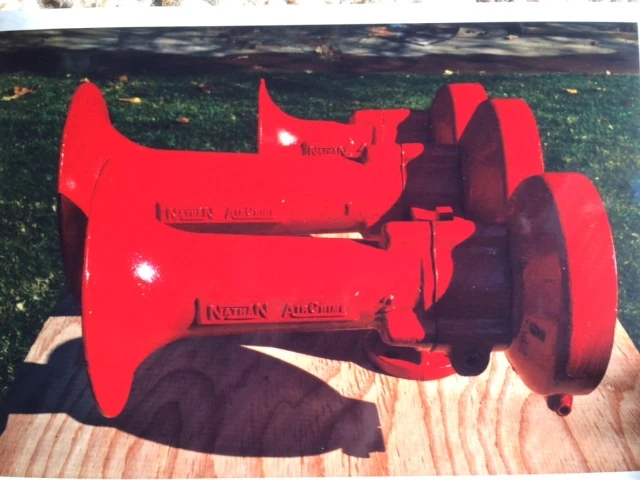
- One refurbished Nathan AirChime M3 three-chime horn (bells, diaphragm assemblies, and manifold base)
- Powder-coat finish in Black, Silver, or a custom color of your choice
- One-year warranty and 100% satisfaction guarantee from the seller
That is the entire package — this is a bare horn, not a kit. You still need an air source capable of feeding it (a large tank and a serious compressor, or a semi truck’s onboard air), a valve to fire it, mounting hardware, and 1/2” plumbing. Budget accordingly: the horn is only the first half of the project. Our air tank size guide and PSI guide cover the supporting system.
Pros
- Authentic 1950s locomotive hardware — the horn family collectors call the most musical ever made
- Warm C♯–E–A chord with documented bell frequencies from Nathan’s own 1951 catalog
- Flexible operating range (20 to over 100 PSI), so it still sounds true at reduced pressure
- Refurbished, powder-coated to order, and backed by a one-year warranty
- Serviceable design: only two wearing parts per bell, per the original catalog
Cons
- Bare horn only — no compressor, tank, valve, or mounting hardware included
- No official dB rating exists, and vendor loudness claims for M-series horns are unverifiable
- Out of production for decades; parts support is scavenge-and-collector territory, unlike the current K and P series
- Premium price for a three-chime, and up to 2–3 weeks lead time before shipping
- Seller’s website was unreachable at review time, so current availability needs confirming
Alternatives
- Nathan AirChime P3 — the M-series’ direct successor: still a genuine cast locomotive three-chime, still in Nathan’s catalog, cheaper as a refurb (renewed examples run around $1,700 at HornBlasters) and far easier to support. Our Nathan P3 review covers it in depth.
- Nathan AirChime K3LA — the modern standard three-chime heard on American roads today; renewed K3 horns list around $1,950. See our K3LA review.
- Leslie S-3L Supertyfon — the classic Leslie alternative if you want a locomotive three-chime with a different tonal character; see our S-3L review.
More Nathan horns are covered on our Nathan reviews hub.
Install / compatibility notes
The 1951 catalog’s installation guidance still applies. The horn mounts on a flat pad with a thick oil-resistant rubber gasket beneath the base, and Nathan specifies a 1/2-inch minimum air supply line “free from restricting elbows and fittings” for maximum volume. Air enters through a bottom inlet port or one of two alternate ports on the base. Each base ships with an air choke — a center-drilled plug in the inlet — which can be removed or drilled out for a louder tone, or swapped for a smaller aperture to soften it; that, plus the horn’s tolerance for 20–100+ PSI, gives you real volume control without ruining the chord.
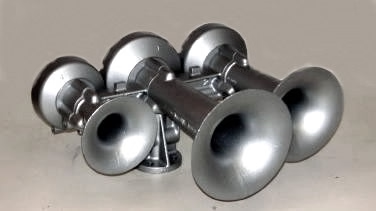
On a pickup, plan for a large tank (5 gallons or more), a high-output compressor, a 1/2” electric solenoid valve, and serious mounting — at 28 pounds of cast aluminum, this is not a horn you zip-tie behind a bumper. Semi trucks with existing onboard air are the natural host. Before buying any used example instead of a refurb, read our used locomotive horn buying checklist; diaphragm condition and base corrosion make or break these horns.
Sources
- Air Horns of Texas — Nathan Airchime M3 Train Horn product page — price variants ($1,550 Black/Silver, $1,650 Custom), powder-coat options, 2–3 week lead time (verified via October 2025 archived capture; site unreachable at review time)
- Air Horns of Texas — homepage — one-year warranty, 100% satisfaction guarantee, 27+ years in business (via March 2026 archived capture)
- Nathan Airchime 1951 M-series catalog (scanned PDF) — M3 weight (28 lb), bells 1/2/4, bell pitches and frequencies, 20–100+ PSI operating range, aluminum construction, phosphor-bronze diaphragms, 1/2” supply line, air choke, service applications
- Wikipedia — Nathan Manufacturing — M-series history, Robert Swanson and Charles Benter, M3H as Canadian standard, succession by P-series
- Wikipedia — United States Navy Band — Charles Benter as the band’s first leader (1925–1942)
- Nathan Airchime — official site — current catalog (K, C, P, KSJ series only; no M-series)
- HornBlasters — AirChime Railway Horns collection — renewed K3 ($1,949.99) and P3 ($1,699.99) pricing for comparison
- eBay — Nathan Airchime category — active used market for original M3/M3H horns
- YouTube — May 1950 Nathan AirChime M3 — sound demonstration of an original 1950 M3
- YouTube — Nathan Airchime M3H Real Train Horn — M3H sound demonstration
Train Horn Hub aggregates publicly available data. We do not test products in-house. All trademarks belong to their respective owners.
A magnificent-sounding piece of railroad history for collectors and dedicated builders who already have (or will build) a serious air system; first-time buyers wanting a supported, ready-to-run locomotive horn are better served by a renewed Nathan P3 or K3LA.
Frequently asked questions
Quick answers to the questions people ask most about this topic.
- How loud is the Nathan AirChime M3 really?
- There is no official decibel rating - Nathan never published one for the M-series, and it predates modern measurement standards. It is a genuine locomotive-class horn that the 1951 catalog says penetrates for miles at full pressure, but any specific '160-170 dB' figure attached to listings is marketing, not measurement.
- What notes does the M3 play?
- Per the 1951 Nathan catalog, the M3 uses bells 1, 2, and 4, tuned to C-sharp (277.18 Hz), E (329.6 Hz), and A (440.0 Hz) - an A-major chord in first inversion.
- What PSI does the Nathan M3 need?
- The 1951 catalog states all Airchimes blow at 20 to over 100 PSI. It sounds a true chord at low pressure and reaches full locomotive volume near the top of that range, so a 100-150 PSI truck air system feeds it well.
- Is the M3 still made, and can I get parts?
- No. Nathan's current catalog covers only the K, C, P, and KSJ series, so every M3 is decades old. Refurbished examples with a one-year warranty are the safest route; otherwise parts come from the collector and used-horn market.
- What is the difference between the M3 and M3H?
- The M3 is the US model using bells 1, 2, and 4, while the Canadian-built M3H used bells 2, 3, and 4 and became the standard three-chime horn on Canadian railroads.